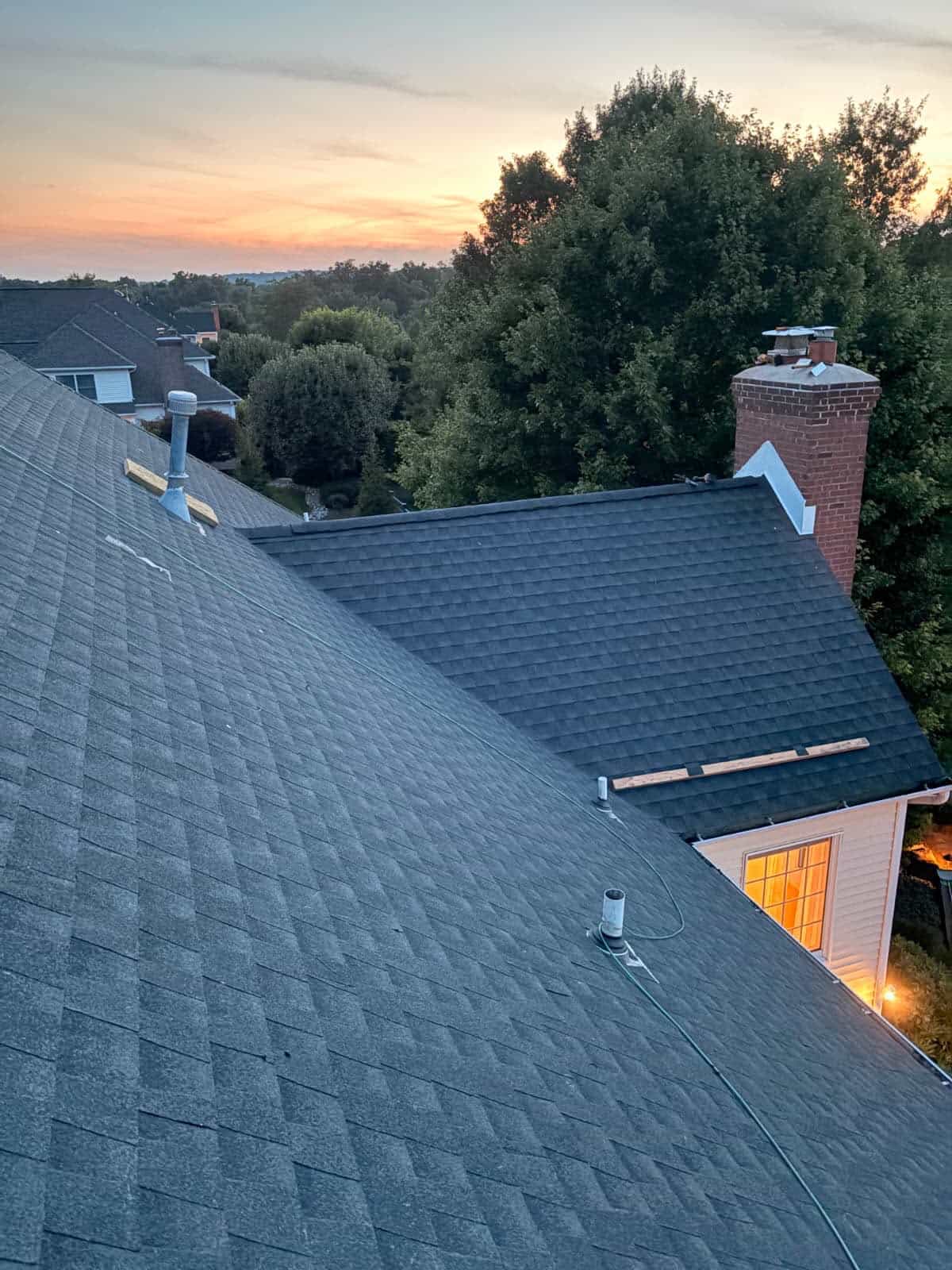
Flashing is the number one cause of roof leaks — the metal at chimneys, walls, valleys and vent penetrations, not the shingle field in between. On the roofs we open across Bergen and Passaic, the water is at a chimney, a valley, a pipe boot or a roof-to-wall transition nearly every time, and almost never out in the open. What we will not give you is the percentage every other roofing site does, because the 90 percent figure they all quote has no study behind it.
That second sentence costs us the easy authority claim, so here is the version that holds up instead. In the IRC as New Jersey adopts it, R908.6 requires that flashings be reconstructed in accordance with approved manufacturer's installation instructions on a reroof — reconstructed, not reused — and the code says nothing comparable about the field. The code treats the details as the failure point. So does every roof we have ever opened. Below: where water actually gets in, in order; why the flashing failed, which is nearly always a decision somebody made to save money; the parts that quit on a clock; and the two cases where the water is not a leak at all and there is nothing for us to sell you.
Where North Jersey roofs actually leak, in order
Contrary to how most people picture it, the shingle field in the middle of a roof rarely leaks. Water gets in at the transitions and penetrations — the seams, edges and holes where the roof meets something else. The same handful of culprits come up again and again.
- Flashing failure. The metal that sheds water at walls, chimneys, valleys and vents. Missing, corroded, or installed wrong, it leaks. The most common serious leak we find.
- Chimneys. Almost always the flashing, not the masonry: failed step flashing tucked under the shingles, or counter flashing where it meets the brick.
- Valleys. The channel where two planes meet carries runoff from both at once, so failed valley metal leaks fast after heavy rain or snowmelt.
- Skylights. Usually the flashing kit or the glazing seal — rarely a skylight that is simply bad.
- Pipe boots. The neoprene collar around a plumbing vent goes brittle and splits. A small, cheap failure that leaks like a much bigger one.
- Nail pops. A backed-out fastener lifts the shingle and lets water run down the nail shank, leaving a rust trail that points right at the source.
- Ice dams. A North Jersey winter classic, and its own section below.
- Drip edge. Missing or undersized, water wraps back onto the fascia and rots the roof edge from the outside in.
About that 90 percent figure — we chased it and it is not there
Search this question and you will be told, in confident language, that 90 percent of roof leaks start at flashing, usually attributed to the National Roofing Contractors Association. We went looking for the document. There is not one. NRCA's own published guidance on flashings makes no such claim.
What the figure traces back to is a January 2001 article in IIBEC's Interface journal — Michael Kubal's Leaking Envelopes — whose actual sentence begins with the words "It is said that" and describes commercial building envelopes generally, not residential roofs. A sentence beginning "it is said" is not data. There is also a widely repeated line attributing roughly 62 percent of residential leaks to valleys, chimney flashing and pipe boots "per NRCA field data"; that traces to a single contractor blog with no source document, and we treat it as fabricated.
So take this as craft observation, stated as such: on our jobs the leak is at a chimney, a valley, a pipe boot or a wall transition almost every time, and almost never in the middle of a shingle field. That is what we see, and it is consistent with what the code requires to be rebuilt on a reroof. It is not a statistic, and anyone who hands you one with NRCA's name on it cannot produce the document either.
The #1 cause of a flashing leak is a decision somebody made to save money
This is the part worth acting on, because every item here is priceable and inspectable before you sign anything.
Flashing is a small share of a roof's material cost and a large share of its skill, which makes it the easiest place to shave a bid. Redoing chimney flashing properly takes extra time and sometimes masonry work, so it gets left off an estimate to come in cheaper — the old flashing bent back down and tarred over instead. Tearing off the old roof loosens even sound flashing, so a reused detail starts leaking as the new roof settles. That is how a brand-new roof leaks at the chimney in its first hard winter.
Sealant is the tell that hides the tell. Asphalt roof cement and caulk have a service life measured in a handful of North Jersey summers, and sealant over a missing or reversed flashing is a countdown that conceals the defect while it runs. The two failure modes are identical everywhere they occur: omitted and caulked over, or lapped backwards into a funnel.
- Reused step flashing. Step flashing at walls and dormers gets replaced, never reused. Reused flashing arrives with old nail holes in it.
- A missing kick-out. R903.2.1 requires a diverter where the eave of a sloped roof meets a vertical sidewall. Plenty of crews still leave it off, and the whole slope's runoff then drops behind the siding — where nothing looks wrong on the roof and nothing looks wrong on the wall.
- No cricket on a wide chimney. R903.2.2 draws the line at a chimney more than 30 inches wide, measured perpendicular to the slope. On older North Jersey houses there frequently is not one, and the uphill face becomes a debris trap by design.
- Reversed drip edge sequence. R905.2.8.5 wants underlayment over the drip edge at the eave and under it at the rake. Reverse it, as rushed jobs do, and you have built a path instead of a barrier.
- Boots reused with the roof. A bid reading "reuse existing flashing" is quoting a new roof with the old failure points left in it.
The most common roof repair, and why it is not a shingle
People expect the answer to be replacing blown-off shingles. In our work it is not. The most common repair we do is renewing a short-clock component threaded through a roof that is otherwise fine — a split pipe boot, a length of step or counter flashing, a reglet where the sealant has opened, a run of backed-out fasteners, a valley cleared and re-detailed.
There is a reason for that, and it is the most useful frame we know for an aging roof: a 30-year roof is made of 12-year parts. The field is the component engineered to shed water and it is generally the last thing to quit. What quits first is the rubber, sealant, fasteners and metal running through it — most of which is designed to be serviced, and almost none of which ever is.
- Pipe boots. Roughly ten to fifteen years is a normal service life for the collar — but the identical boot ages visibly faster on a south- or west-facing slope than on the north side of the same roof. Exposure tells you which ones to check first, not age.
- Sealant. Asphalt roof cement and the sealant packed into a counter-flashing reglet are maintenance materials, not permanent ones. They shrink as they cure and open a hairline that rain finds long before you do.
- Exposed fasteners. Ridge caps, vent end-caps and any face-nailed detail loosen as the deck expands and contracts through the seasons. A backed-out nail is a hole with a shingle sitting over it.
- Seal strips. Architectural shingles bond course to course on a heat-activated adhesive. A tab that a February gust breaks loose will not reliably re-bond on its own and stays a wind target until somebody hand-seals it.
- Valleys and the back of the chimney. Wherever a roof concentrates water it concentrates debris, and flashing metal that would outlive the shingles corrodes fast under six months of wet leaf litter.
Why wind-rated shingles still blow off in a North Jersey storm
North Jersey takes nor'easters, summer downbursts and the tails of tropical systems — Ida in 2021 is still fresh — and wind is what lifts and strips asphalt. Loss concentrates at corners, the ridge, the rakes and the windward slope, which is also why a storm-damaged roof rarely looks damaged from the front of the house.
When a 110 to 130 mph shingle comes off at 60, the cause is almost always installation rather than product.
- Nails driven above the nailing zone, so they never caught the course below. The fastener is in the shingle and not in the lap.
- A missing or improvised starter strip at the eave or the rake. Cut-down field shingles are not a starter course, and manufacturers condition their higher wind coverage on purpose-made starter at both.
- Installed cold and never hand-sealed. Below roughly 40°F, factory sealant strips will not activate on their own. A roof laid in February that nobody hand-sealed is a roof waiting for March.
Winter: the leak that is not a flashing leak
Ice dams are the seasonal exception, and they route water into the house at a place flashing has nothing to do with — the top-floor ceiling-to-wall corner, or the head of a top-floor window.
The mechanism is upstream of the roof. The house warms its own upper deck from underneath, snow lying on that deck melts, the water runs down and arrives at the overhang, which covers nothing heated and sits at outside temperature, where it freezes into a ridge. Behind the ridge the meltwater stops moving and stands. Shingles work by lap and gravity and have no answer to standing water.
So the fix is attic, not shingles. R806 sets the ventilation baseline — one square foot of net free ventilating area per 150 square feet of the vented space, relaxed to 1/300 when 40 to 50 percent sits high, within three feet of the ridge, with the balance low. The failure we find most is blocked intake: insulation packed over the soffits with no baffles, or original soffit vents painted until the perforations closed, so the ridge vent has nothing to pull.
And the code claim to distrust, because it is the most consistently misstated fact in North Jersey roofing: an ice barrier at the eaves is not required here. New Jersey struck the model code's history-of-icing trigger at adoption and inserted areas where the average daily temperature in January is 25°F (-4°C) or less, and DCA Bulletin 07-3 states that for the State of New Jersey that area is Sussex County. Everywhere else it is best practice, which is how we spec it — and be clear about what it buys. The membrane has no effect on whether a dam forms. The attic decides that. All the membrane decides is whether the dam ends up on your ceiling.
When it is not a leak, and there is nothing for us to sell
Two cases account for most of the water we get called about that no roofer should be paid to fix.
Attic condensation. Household air that has found its way above the ceiling meets a deck sitting at outdoor temperature, gives up its moisture there, and rains it back onto the insulation. Indistinguishable from a leak until you check the calendar: it happens in the coldest week of the year, often under a clear sky, with no precipitation of any kind. Air sealing and balanced intake, not shingles.
Mechanical water. Condensate lines that have silted up, drip pans under attic air handlers that rusted through, ductwork sweating in an unconditioned space, a vent stack, a supply line inside a wall. Timing gives all of them away — they track the cooling season, or they track nothing at all.
Which is why the highest-signal evidence you have is not where the water shows up but when. Log two or three events with the date, the rain intensity, the wind direction and the temperature. Wind-driven rain from one direction points at a wall or a window. Any heavy rain, worse the longer it rains, points at the roof. Snow or a thaw with no rain falling points at an ice dam. Cold weather with no precipitation at all points at your own indoor humidity, and if we come out and find condensation we will tell you to run the bath fan and buy a hygrometer, and there is nothing for us to sell.
So what is the #1 cause of roof leaks in New Jersey?
Flashing — the metal at chimneys, walls, valleys and penetrations. Not the shingles, not the age of the roof, and not the brand on the bundle. We will not put a percentage on it because the percentage everybody quotes has no source, but the code requires flashings to be reconstructed on a reroof and requires nothing similar of the field, and that is a better argument than a number nobody can produce.
The practical version, for a roof you already own: leaks concentrate at penetrations and transitions far more than in the open field, which means a single stain on a bedroom ceiling is usually a small job in a frightening costume. Water past a roof detail runs six to eight feet between where it got in and where it drops, routinely more, so the entry point is not above the stain. And most repairs at that scale need no permit in this state — N.J.A.C. 5:23-2.7(c)1x makes the repair or replacement of existing roof covering on a detached one- or two-family ordinary maintenance, though the moment work touches decking, framing, or adds a penetration, 5:23-2.7(b)4 puts it back under permit.
We trace leaks rather than guess at them — attic first with a light, working uphill, and a controlled water test isolating one plane at a time when the leak is intermittent. If it turns out to be a boot and a length of flashing, that is what we will quote, even though the tear-off is the bigger ticket for us. (201) 275-9185, HIC reg.# 13VH13970900.