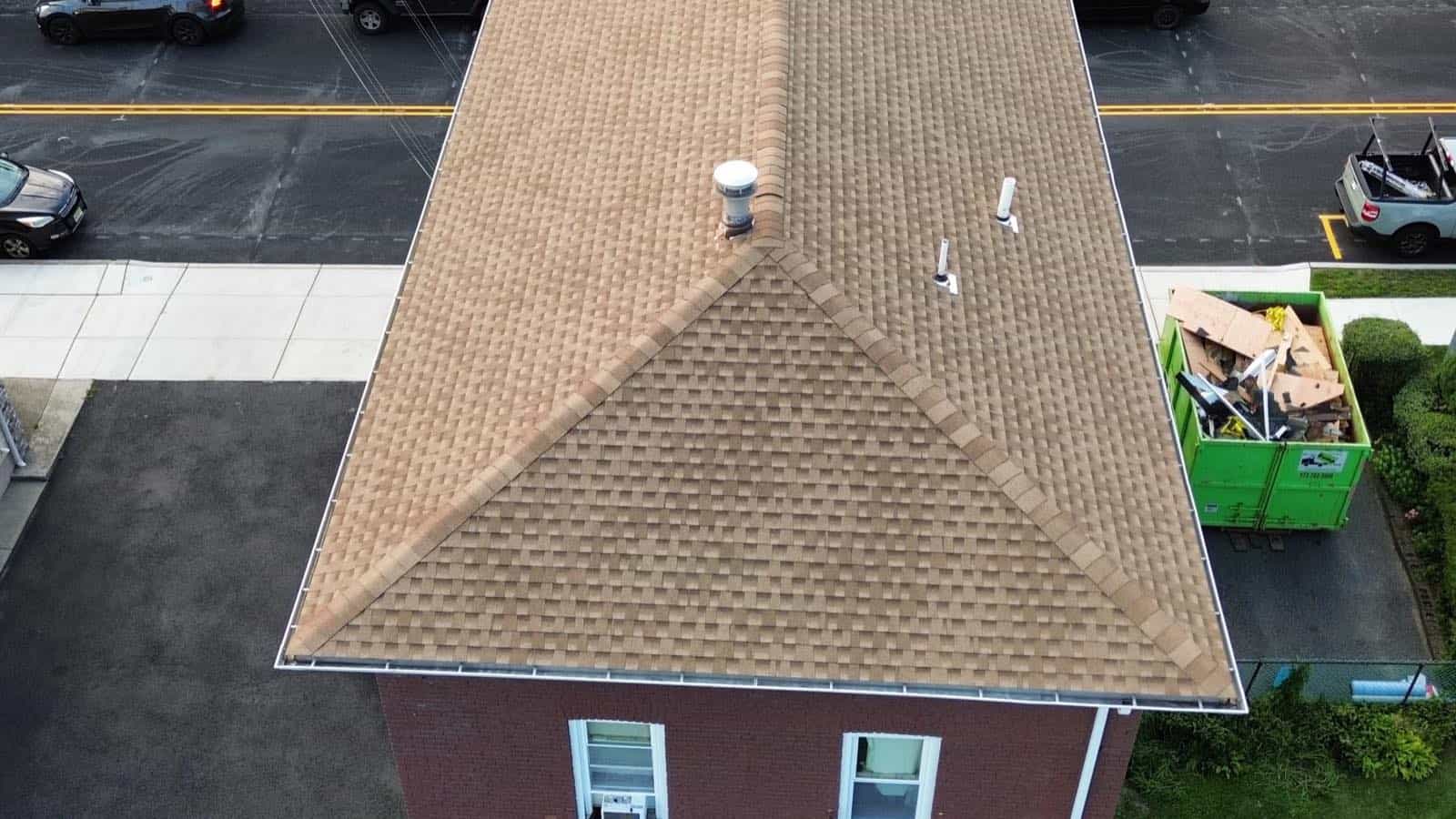
Condition decides it, not age. A 20-year-old roof lying flat with its granules intact and nothing leaking is a roof you keep, and no rule in New Jersey says otherwise. What ends a roof at twenty is granule loss across the whole field rather than in the wear paths, curling or cupping over multiple slopes, shingles that crack under a knee instead of flexing, and more than one soft spot underfoot in the deck. And if what brought you here is a letter from your insurer, know this first: there is no roof-age cutoff in New Jersey law and no state agency publishes one, so you are reading an underwriting guideline your carrier chose.
Most people asking this question at exactly twenty years are not asking because the ceiling is wet. They are asking because a home inspector wrote a sentence, a realtor said something, or an envelope arrived with a deadline on it. Those are three different problems with three different answers, and only one of them is a roofing question. Below: the physical tells that settle it, what the covering type does and does not tell you, the ventilation condition that decides whether any roof reaches its number, and the New Jersey insurance rules that apply when the trigger was a letter rather than a leak.
The tells that override the calendar
There is a point where a roof stops having life to preserve, and the tells are consistent. Look for these before you look at the date on the paperwork.
- Granule loss across the whole field, not concentrated in the wear paths, with grit in the gutters after every rain. The asphalt layer is what holds water out; granules are what protect it from UV.
- Curling or cupping over multiple slopes. One slope is exposure. Several is age.
- Shingles that crack under a knee instead of flexing. A brittle shingle cannot be walked, which also means it cannot be repaired without breaking its neighbours.
- More than one soft spot underfoot in the deck. The one symptom that can mean structure rather than surface, and the reason nobody should be diagnosing this from the driveway.
- A sagging ridgeline. Same category. Inspected before anything else.
- Repairs that keep coming back to different places. A roof failing in one spot is a repair. A roof failing in a new spot every season is finished.
At that stage the flashing is usually still fine — which is the point
Here is the pattern that surprises homeowners. On a roof that is genuinely spent, the flashing details are often still in good order and the field is what has quit. That is exactly the failure maintenance cannot solve, and it is the honest signal that you are looking at a replacement rather than another service call.
The inverse is far more common at twenty years, and it is the reason we walk away from a lot of these visits with a repair scope instead of a contract. One layer, shingles still lying flat with their granules largely intact, water showing up in one place under one penetration — that is a flashing or a boot failure, and the fix is a repair. A roof with one wind-damaged slope and ten good years left is an easy repair. A roof on its third layer, shedding granules everywhere, with brittle shingles that crack when you walk them, is throwing good money after bad.
We also decline a claim that gets repeated a lot in this corner of the trade: that maintenance adds some specific number of years to a roof. The life-extension figures that circulate come out of commercial low-slope roofing studies rather than residential asphalt shingles. Nobody can tell you how many years a maintenance program adds to a particular shingle roof. What is defensible is narrower: maintenance changes which failure you get. It keeps a roof from failing early at a cracked boot or a clogged valley. It does not turn a twenty-two-year roof into a thirty-year roof.
What the covering tells you, and what nobody actually publishes
The internet will tell you 3-tab lasts 15 to 20 years and architectural lasts 25 to 30. We are not going to repeat that, because we cannot source it, and neither can the sites quoting it. There is no published study that separates residential asphalt service life by shingle grade. The one broad reference that exists — the NAHB and Bank of America Study of Life Expectancy of Housing Components — lists asphalt at about 20 years flat, does not distinguish the two grades, and is a 2007 telephone survey of manufacturers and trade associations. It also states up front that life expectancy depends on installation quality, maintenance, weather and climate.
What the two grades genuinely differ on is documented, and it is warranty and wind rating rather than measured lifespan. 3-tab is the budget grade: a flat single-layer sheet, lower wind ratings, warranties that typically top out around 25 years. Architectural shingles, also called dimensional or laminate, are thicker and multi-layered, carry wind ratings often in the 110 to 130 mph range, and come with 30-year-to-lifetime warranties. In North Jersey wind, that rating difference is the one that shows up in real life.
And on the word that does most of the damage: a "lifetime limited" warranty covers defects in the product for as long as you own the home. It does not mean the roof lasts a lifetime. Inside it sits a non-prorated period at the front, after which coverage prorates down against the age of the roof. That is a document about manufacturing defects, not a prediction about your shingles, and reading it as a lifespan claim is how a homeowner ends up surprised at year twenty.
Ventilation is what decided whether your roof reached its number
If your roof is failing early, this is usually why, and it is worth checking before you spend anything — because it will do the same thing to the new roof.
The IRC as New Jersey adopts it sets the baseline at R806: not less than one square foot of net free ventilating area per 150 square feet of the vented space, relaxed to 1/300 when 40 to 50 percent of the required area sits in the upper portion of the attic within three feet of the ridge, with the balance low. In plain terms, air has to come in at the soffits and leave at the ridge.
The failure we find most is blocked intake, not missing exhaust. Insulation blown or batted over the eave with no baffles behind it packs the soffit solid from the inside while the vented panels below still look perfect. Original wood soffit vents get painted until the perforations close. A bath fan gets dumped into the attic instead of ducted through the roof. A ridge vent's filter mats over with pollen. None of it announces itself, and a ridge vent with no intake to pull from is decoration.
This is also a warranty condition, not an upgrade. GAF's base Shingle & Accessory Limited Warranty excludes damage resulting from anything other than an inherent manufacturing defect, and lists inadequate attic ventilation by name alongside improper fastening or application and settlement or movement of the building. An unvented attic bakes shingles from underneath and hands the manufacturer a written reason to say no.
When the trigger was an insurance letter, not a leak
This runs under a different chapter of New Jersey regulation than anything a roofer normally deals with, and almost none of the claim advice online applies to it.
Start with the clock. N.J.A.C. 11:1-20 expressly covers homeowners policies, and it requires that a non-renewal notice be mailed or delivered not more than 120 days nor less than 30 days before the policy expires. The notice must contain the standard or reason the termination is premised on and specify in detail the factual basis the insurer relies on. Roof condition is a standard. Overhead imagery dated the fourth of March showing granule loss on the south slope is a factual basis. If your letter is closer to the first than the second, that gap is the appropriate first question — in writing.
Then the leverage almost nobody uses. N.J.A.C. 11:1-20.3(a) puts a provision in every New Jersey homeowners policy stating that the underwriting reasons or guidelines the insurer can use are maintained in writing and will be furnished to the insured upon written request. Ask for it, in writing, to the insurer and not only the agent. What comes back turns an argument about your roof into an argument about a written rule — its wording, its effective date, and whether the facts stated in your notice actually satisfy it.
Where roof age sits is worth knowing. N.J.A.C. 11:1-20.4(b) sets out thirteen guidelines approved for use, and roof age is not among them. That does not make a roof-age rule unlawful — subsection (d) permits other guidelines, carrying exactly one test: not arbitrary, capricious or unfairly discriminatory. The same standard appears in statute at N.J.S.A. 17:22-6.14a1, and the Department of Banking and Insurance has ordered carriers to file their homeowners underwriting guidelines with the Department. If roof age were fixed by law, DOBI would not need to collect each company's rules to find out what they do.
The quiet outcome that costs more than non-renewal
A letter you can read is the loud version. The expensive version is a renewal you accept without reading, in which the roof covering has been moved from replacement cost to actual cash value.
DOBI defines the two plainly: actual cash value means the value of the item as it is now, considering its age and condition; replacement cost is what it would take to repair or replace with materials of like kind and quality at today's prices. On a roof the gap between those two numbers is large, and it widens every year, because the depreciation runs against the covering's age. On a replacement-cost policy the carrier pays actual cash value first and releases the withheld depreciation only after the work is finished and invoiced. An ACV-only settlement never reimburses full replacement.
Read your declarations page for endorsements named for roof surfacing, actual cash value, windstorm or hail losses to roof surfacing, or scheduled roof surfaces. And check your deductible while you are in there: New Jersey homeowners can select a separate windstorm or hail deductible, which DOBI describes as optional and premium-reducing — a fixed dollar amount, or a percentage of the Coverage A limits up to 10 percent. A separate hurricane deductible applies only to a loss during an event the National Weather Service designates a hurricane, and only if sustained winds of 74 mph have been measured anywhere in New Jersey. DOBI's own examples show the scale: a $200,000 home with a 2 percent hurricane deductible has a $4,000 deductible; a $500,000 home at 5 percent has a $25,000 one. On a twenty-year roof, that number is frequently why a claim is not worth filing.
Two things not to do while you decide
Both are common, and both make the situation worse.
- Do not file a claim to solve an age problem. Wear, age and deferred maintenance are generally not covered perils, so the likely outcome is a denial — which lands in your loss history at the exact moment you are about to shop the policy. A 22-year-old roof at the natural end of its service life is a hard claim to win. A 9-year-old roof with a fresh row of shingles peeled off after a named windstorm is a clear one.
- Do not assume a new roof guarantees renewal. It often helps. Nothing in New Jersey law obliges a carrier to renew because work was done, and the guideline you are being measured against may not be about age at all.
- Do not answer the letter with an opinion. Answer it with a dated, photographed, written condition report from a registered New Jersey contractor — the thing an underwriter asked for and an aerial image cannot supply.
- Do not let the deadline run. Count from the mailing date to your expiration date before doing anything else. Where an insurer fails to send the notice the subchapter requires, 11:1-20.2(j) entitles you to continue the expiring policy at the same terms and premium until proper notice is sent.
So should a 20-year-old roof be replaced?
Only if the roof says so. Twenty years is an age, not a diagnosis, and the honest answer requires somebody on the roof and in the attic: granules, curl, brittleness, deck feel, ventilation, and whether the failures are one place or everywhere. If the field is spent, replace it, and read this site's cost guide before you compare bids. If it is one boot, one length of flashing or one valley, that is a repair and it is not close.
Here is the part that costs us the job, stated plainly: a 20-year-old roof that is not leaking, is not shedding granules across the field, and is not the subject of a non-renewal letter does not need replacing, and we will tell you that at the estimate and leave. We would rather be the company you call in five years with a real failure than the one that sold you a roof a year early. Free inspection and written condition report across New Jersey, from the shop in Garfield. (201) 275-9185, HIC reg.# 13VH13970900.