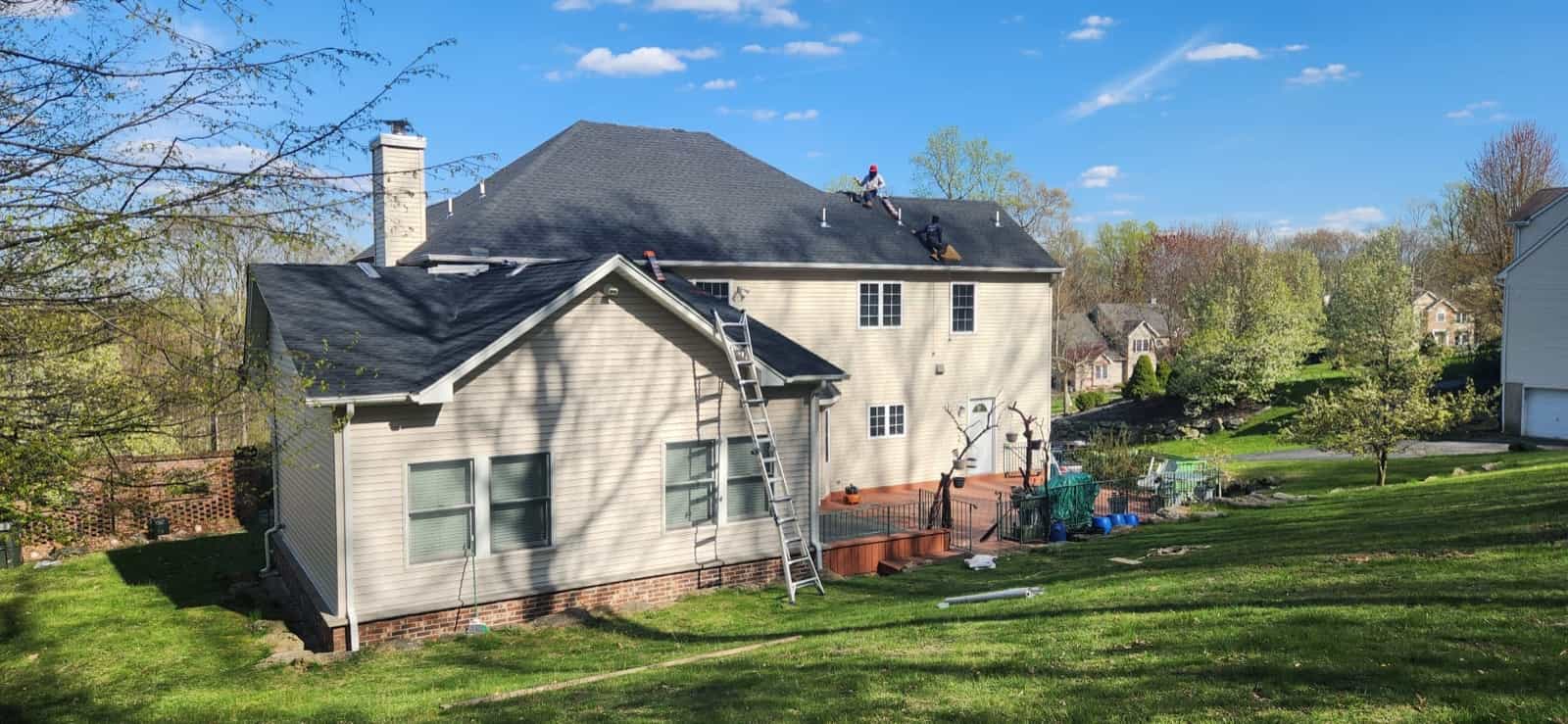
Not automatically. Thirty thousand dollars sits at the top of the North Jersey range for architectural asphalt shingles on a 2,000 sq ft roof rather than outside it, so the real question is what put your bid there. Architectural shingles on an ordinary 2,000 sq ft roof, with one layer off and a walkable pitch, run about $11,000 to $20,000 installed, and up to roughly $30,000 once steep pitch, valleys and dormers, a second layer, decking and hard access are counted. That makes $30,000 an ordinary number for a steep, cut-up, two-layer or hard-access roof, and a high one for a simple gable — and the difference between those two roofs has a name that belongs on the bid you are holding.
We are roofers, so read this the way you would read a bid: we have an interest in you believing that large numbers are normal. What follows is the arithmetic instead — the per-square breakdown that shows a contractor's math, the six things that actually move the total, the New Jersey rules that decide whether a cheaper option is even legal, and the specific cases where our answer is that $30,000 is too much and you should keep shopping. Every figure below comes from the market ranges published on our roof replacement cost guide and roof cost calculator. Those are estimates compiled from national cost aggregators and New Jersey contractor data for sanity-checking a bid. They are not our quote, and no honest range is.
Start with squares, because that is the unit your bid was written in
Roofers price in squares, not square feet. One roofing square is 100 square feet of roof surface, so a 2,000 sq ft roof is 20 squares. In 2026 North NJ, an ordinary 2,000 sq ft architectural-shingle roof runs about $11,000 to $20,000 installed, and the shingles are only part of it — the rest is labor, tear-off, underlayment, flashing and disposal. A contractor who can tell you your square count and their per-square rate is showing their math. One who quotes only a lump sum is hiding it.
The first thing that arithmetic usually corrects is the size. Your roof's square footage is not your home's floor area: a steeper roof covers the same footprint with far more surface, so an 1,800 sq ft house can carry a 2,400 sq ft roof once you account for pitch and overhangs. Plenty of homeowners decide a bid is outrageous by comparing it against a size tier their roof was never in. On an ordinary roof, architectural shingles run about $8,500 to $15,000 at 1,500 sq ft and $16,500 to $30,000 at 3,000 sq ft, so knowing which size you are actually in changes the verdict before anything else does.
So the useful move is not to argue the total. It is to make the bid name the driver. Multiply your square count by the per-square rate the contractor quotes and see whether the product resembles the total; where it does not, something specific is doing the work — pitch, a buried layer, decking, access or a different covering entirely — and each of those is a line item with a name, not a mood. A bid that cannot name the driver has not earned the price, whatever the price is.
When $30,000 is too much in North Jersey
These are the cases where we would tell you to keep shopping, including past us.
- A simple single-layer gable under 2,000 square feet. Two planes, no valleys, no dormers, one layer coming off, a driveway to park the dumpster in. That is an ordinary roof, and ordinary 2,000 sq ft architectural roofs in North Jersey run about $11,000 to $20,000.
- A lump sum with no square count. If the bid cannot say how many squares it is pricing, nobody measured your roof. That is a guess wearing the clothes of a quote.
- 3-tab shingles at an architectural price. 3-tab on an ordinary 2,000 sq ft roof runs about $9,000 to $15,000 in this market. If the material line says 3-tab and the total says $30,000, the mismatch is the entire conversation.
- Nothing on the bid that explains the number. Steepness, layer count, decking, staging and access are what carry a roof past the ordinary range. If none of them appears in writing, the price has no support under it.
- A price that drops when you hesitate. Several thousand dollars off in one phone call means the first number was never a measurement, and neither is the second.
When $30,000 is a fair number in North Jersey
And these are the roofs where $30,000 is ordinary, and a bid several thousand below it is the one to be suspicious of.
- Two layers coming off, usually alongside something else. A buried second layer adds about $1,000 to $3,000 on a 2,000 sq ft roof in removal labor and dump fees, and it often hides deck rot that adds more.
- Steep and cut up. At 6/12 and above a roof needs staging and fall protection and the crew moves slower, so the labor line rises, and past 8/12 that compounds — and a steeper roof has more surface to cover than its footprint suggests.
- A bigger roof than the house implies. An ordinary 3,000 sq ft architectural roof runs about $16,500 to $30,000 before any steep pitch or second layer, so a big simple roof can reach $30,000 on size alone. Confirm the roof's real area before you judge the total.
- Standing-seam metal, not asphalt. Standing-seam metal on a 2,000 sq ft roof runs about $22,000 to $42,000. At $30,000 that is an ordinary standing-seam metal roof, not an expensive shingle roof.
- Access that costs a day. Three stories, a tight urban lot, power lines, nowhere to stage a dumpster. Hudson County jobs usually land in the upper half of the North Jersey range even on small footprints, for exactly this reason.
- Chimneys, skylights, dormers and valleys. Every one is flashing and cut-in labor plus waste. Chimney flashing alone runs $300 to $1,800.
Typical is not maximum, and the two numbers are not in conflict
This trips people up, so it is worth stating flatly. The ordinary range, about $11,000 to $20,000, describes a 2,000 sq ft architectural re-roof with one layer off, a walkable pitch and a place to park, and Bergen and Hudson jobs usually sit in its upper half. The $30,000 top of the architectural range describes the same shingle on a roof that is steep, cut up, carrying two layers, or awkward to reach.
The gap is that wide because those factors pile up on the same roof. In our own cost calculator, a steep and cut-up roof, a full strip of two layers, and a second story stack to roughly 1.6 times the price of a simple, single-layer, one-story roof of the same size, before any decking. Any one of them alone is a modest bump. Three together is a different job.
Typical is where most jobs land. It is not a ceiling, and a contractor is not overcharging you because your roof is not typical. What they owe you is the sentence that says which of those factors applies to your house, in writing, before you sign.
Layers and decking: the two lines that decide the top of your range
Before you ask what a cheaper option costs, ask whether it is legal on your roof. New Jersey answers this in its own words, in the Rehabilitation Subcode rather than in a borrowed IRC section. N.J.A.C. 5:23-6.4(e)7 requires the existing roof covering to be removed before new covering goes on in three situations: where the existing roof or covering is water soaked or has deteriorated to the point that it is not an adequate base for additional roofing; where the existing covering is wood shake, slate, clay, cement or asbestos-cement tile; or where the roof already carries two or more applications of any type of covering.
Read that as what it is. The rule does not grant anyone a right to two layers — it prohibits recovering once two are up there. Two is the practical ceiling, not an entitlement, and on housing stock this old plenty of North Jersey roofs are already at it. Note also that New Jersey's list is broader than the model code's: NJ keeps wood shake in the second condition. If somebody offers to shingle over cedar, that is not a judgment call.
The second line is decking, and it is the one line on a roofing bid that honestly cannot be priced in advance. Sheathing condition is invisible until the roof is off, and the soft sheets show up in predictable places — around the chimney, down the valleys, at the eaves where meltwater backed up, and over whatever leak a previous owner patched from outside. Older Passaic County board-deck stock in Paterson, Passaic and Clifton adds decking after tear-off often enough that it belongs in the budget: localized rot typically adds about $500 to $2,000 on an ordinary roof, and a full re-deck about $5,000 to $10,000. The honest handling is a written per-sheet price in the contract — not an estimate, and not a blank line.
The permit answer nearly everyone gets backwards
This one matters to price, because it can be a line on your bid for something the rule says is not required. N.J.A.C. 5:23-2.7(a) provides that ordinary maintenance may be done without filing a permit application or giving notice to the construction official, and the introduction to (c) is explicit: these items are ordinary maintenance and shall be treated as such by every enforcing agency — no permit for, inspections of, or notice to the enforcing agency shall be required. Item (c)1x is, verbatim, the repair or replacement of existing roof covering on detached one- and two-family dwellings.
Two words in that item do real work. Detached — an attached row home or a three-family is outside the exemption from the start, and the drafters used the word deliberately, because the siding item at (c)1xi says one- and two-family with no such qualifier. And covering — decking is not covering. The moment the job touches structure, N.J.A.C. 5:23-2.7(b)4 puts it back under permit, and you can prove that from the rule's own drafting: the deck item at (c)1xiii opens with the words Notwithstanding (b)2 and 4 above. The roofing item carries no such override, so (b)4 still binds it.
Now the part that costs us something to say. No permit also means no town inspector ever looks at your roof. Nobody from the municipality checks the drip edge sequence, the step flashing, the nailing pattern or the underlayment. The contractor is the only check there is, which is why the trade discipline you are buying is most of what the money is for — and why a bid that is cheap because pieces of the system were quietly left out passes unnoticed, permanently. Note too that no permit is not the same as no code: 5:23-6.4(e)7 applies to the work whether or not anyone inspects it.
Why the national number you found online is not your number
Search roof replacement cost and you get national averages for a typical single-family shingle roof. Those are real numbers. They are just not North Jersey numbers, and the reason is not a markup — it is that the labor here costs more, and that is measurable. Average annual pay at New Jersey roofing contractors was $86,103 in 2025, against $73,901 nationally — 16.5 percent higher. In Bergen County it was $87,978, 19 percent higher. Those are payroll figures from the Bureau of Labor Statistics' Quarterly Census of Employment and Wages (2025 annual averages, NAICS 23816, private ownership), not the labor line on a quote — but they are the same pressure, counted rather than estimated. Dense towns, disposal costs and winter-compressed schedules sit on top of it.
Material pricing has moved too, and the manufacturers announce it in writing. GAF raised residential roofing products 6 to 10 percent effective April 1, 2025; Owens Corning raised shingles and accessories 7 to 10 percent, also effective April 1, 2025. Both went again for 2026 — GAF 5 to 8 percent effective April 15, 2026, Owens Corning 5 to 8 percent effective April 1, 2026. If a neighbor's five-year-old quote looks nothing like yours, that is most of the gap right there — and it is also why a bid that matches a national average on a North Jersey roof deserves a harder look than a bid that exceeds it.
If the number is real and still more than you have
Two honest paths, and one of them is not a roof.
We work with Hearth, a lending marketplace that shops several banks on one application; checking is a soft pull. Precision is the contractor and referring broker, not the lender, and every approval belongs to the lender and your credit, not to us. We are roofers, and we will not promise you an approval.
Separately, Bergen County runs a Home Improvement Program for income-qualified owner-occupants that lists Roof, Leaders, Gutters among its eligible improvements. Read the structure before celebrating: nothing is due until the home is sold or title transfers, which makes it a lien rather than money off the job — good if you are staying put, worse if you are about to sell. You apply to the county directly; we cannot bill against it or apply on your behalf.
And the path that costs us the job: if the roof has years left and one localized failure, the answer is a repair, not $30,000. A roof with one wind-damaged slope and ten good years in it is an easy repair, and if a flashing fix gets you five more years we will say so on site, even though the tear-off is the bigger ticket for us.
So — is $30,000 too much for a roof in New Jersey?
Not by itself, and not as a number in the abstract. It is the top of the published North Jersey architectural range for a 2,000 sq ft roof, well above the ordinary $11,000 to $20,000, and squarely inside the metal range. Which of those describes your roof is a question of squares, layers, pitch, access and covering — five facts, all of which a contractor who has been on your roof can state in one paragraph.
So do not argue the total. Ask for the square count, the per-square rate, the layer count, the tear-off line, the per-sheet decking rate, the flashing scope and the covering, and compare those against another bid item by item. If the answers are specific, $30,000 may be exactly right. If they are not, the price is the least of what is missing. We measure and quote in writing for free, with no obligation, out of the Garfield shop. (201) 275-9185, HIC reg.# 13VH13970900.