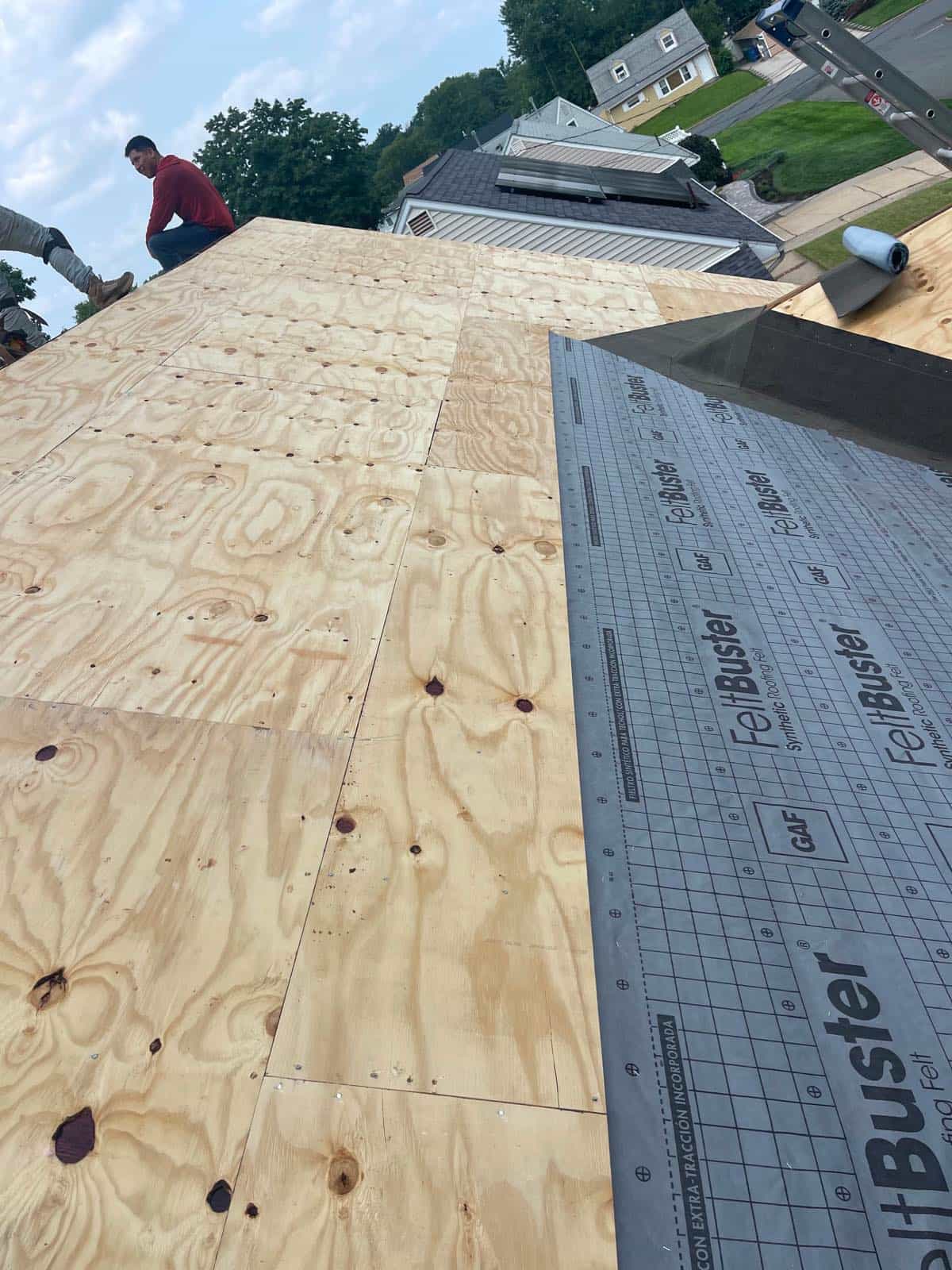
The most expensive part of a new roof is labor — specifically the labor of getting the old roof off and detailing the new one, not the shingle you are choosing between brands on. In North Jersey, an ordinary 2,000 sq ft architectural-shingle roof, with one layer torn off and a walkable pitch, runs about $11,000 to $20,000 installed, and the shingles themselves are one piece of that. Everything else in the number is the crew, the tear-off, the underlayment, the flashing metal and the disposal, which is why two bids on the same house can be thousands apart while quoting the identical shingle.
That has a practical consequence most homeowners get backwards. The part of a roofing bid people shop hardest is the part that moves the total least, and the parts that move it most are the ones nobody can see once the job is done. This walks through them in order of what they cost — tear-off, decking, pitch and access, flashing, the membrane — and names the ones a cheap bid quietly leaves out. Dollar figures below come from the market ranges published on our roof replacement cost guide, which are estimates compiled from cost aggregators and New Jersey contractor data for sanity-checking a bid, not a quote.
Where the money in a roof goes
Roofers price in squares. One square is 100 square feet of roof surface, so a 2,000 sq ft roof is 20 squares. On an ordinary roof that size, with one layer torn off and a walkable pitch, architectural shingles in 2026 North NJ run roughly $11,000 to $20,000 installed, a total that also covers labor, tear-off, underlayment, flashing and disposal.
Depending on the job, the shingles themselves are anywhere from about a tenth of the installed price to a little under half of it. That spread is itself the answer: the shingle is the one component whose share of your bill swings wildly, which is exactly why "which shingle" is the least informative question you can ask a roofer. The stable, unavoidable costs are the ones underneath it.
There is a second reason material is not where the money goes. The step from budget to premium covering is smaller than most people expect — 3-tab on an ordinary 2,000 sq ft roof runs about $9,000 to $15,000 and architectural about $11,000 to $20,000 before complexity — but the ranges overlap enormously, and where a given house lands inside its range is decided by tear-off, pitch, decking and access rather than by the bundle. Two roofs with identical square footage do not consume the same number of bundles either, because a cut-up roof wastes material that a simple gable does not.
Tear-off: the largest single line you can see coming
Removing the old roof is its own line item, and it is never free — a bid showing no tear-off line has either buried it or is not doing it.
A hidden second layer is the surprise. A buried second layer adds about $1,000 to $3,000 on a 2,000 sq ft roof in removal labor and dump fees, and you frequently do not know it is there until somebody lifts a course at the eave. Ask any bidder how many layers they counted and how they counted them.
Before you price the cheaper alternative, check whether it is legal on your roof, and check it against New Jersey's own rule rather than a borrowed IRC section. N.J.A.C. 5:23-6.4(e)7 requires the existing covering to be removed before new covering goes on where the existing roof or covering is water soaked or has deteriorated to the point that it is not an adequate base for additional roofing; where the existing covering is wood shake, slate, clay, cement or asbestos-cement tile; or where the roof already carries two or more applications of any type of covering. New Jersey's list is broader than the model code's — it keeps wood shake — and the rule is a prohibition on recovering, not a grant of a right to two layers.
And no permit does not mean no code. A covering-only re-roof on a detached one- or two-family is ordinary maintenance in this state, so nobody inspects it — but 5:23-6.4(e)7 still governs the work.
Decking: the line that honestly cannot be priced until the roof is open
Every legitimate roofing bid contains one line that is not a price, and this is it. Sheathing condition is invisible until the covering is off, and the soft sheets turn up in predictable places: around the chimney, down the valleys, at the eaves where meltwater backed up, and over whatever leak a previous owner patched from the outside. On older Passaic County board-deck stock in Paterson, Passaic and Clifton, tear-off turns up bad decking often enough that it belongs in the budget from the start.
The honest handling is a written rate rather than an estimate: a price per 4x8 sheet installed, in the contract, before anyone climbs a ladder. Note also what triggers a permit — decking is not covering, so the moment sheathing or framing is replaced, N.J.A.C. 5:23-2.7(b)4 puts the job back under permit.
Here is the line that costs us something to write. A firm decking number given before tear-off is either padded or about to become a change order. Nobody can see through a roof. What a contractor can commit to is the rate, the photographic evidence, and the count — so ask for bad sheets to be photographed in place before they come out and for the count to be called to you before the new deck is covered. Once underlayment is down, nobody can audit anything.
Pitch, complexity and access are labor, not material
These three are why two roofs of identical size are thousands apart, and every one of them is a labor cost with no material attached.
- Pitch. At 6/12 and above a roof needs staging and fall protection and the crew moves slower, so the labor line rises, and past 8/12 that compounds. A steeper roof also has more surface than its footprint implies, so it is paying twice.
- Complexity. Valleys, dormers, chimneys, skylights and multiple pipe penetrations all mean more flashing and more cut-in labor than a simple gable — plus waste, because a cut-up roof consumes more bundles per square than a plain one.
- Access. A three-story or tightly sited home needs more staging, ladders and hauling than a ranch a dump trailer can pull right up to. Hudson County totals stay high on small footprints for exactly this reason.
- Weather window. Below roughly 40°F, factory sealant strips will not activate on their own, which means somebody has to hand-seal — more labor on a cold-season install, and a defect on the cheap version of it.
The metal is where a cheap bid actually gets cheap
Flashing is a small share of the material cost and a large share of the skill, which makes it the easiest place to save money at your expense. Chimney flashing runs $300 to $1,800, and redoing it correctly takes extra time and sometimes masonry work — so it gets left off an estimate to come in lower, with the old flashing bent back down and tarred over instead.
That does not stay hidden for long. Tearing off the old roof loosens even sound flashing, so a reused detail starts leaking as the new roof settles — which is how a brand-new roof leaks at the chimney in its first hard winter. Caulk and tar over a flashing defect have a service life measured in a handful of North Jersey summers, and they hide the defect while they run.
The code, notably, agrees about where the risk is. In the IRC as New Jersey adopts it, R908.6 requires that flashings be reconstructed in accordance with approved manufacturer's installation instructions on a reroof — reconstructed, not reused — and says nothing comparable about the shingle field. Three items to check by name on any bid:
- Step flashing at walls and dormers, replaced rather than reused. Reused step flashing arrives with old nail holes in it.
- A kick-out where an eave dies into a sidewall. R903.2.1 requires a diverter at that intersection, and plenty of crews still leave it off — after which a whole slope's runoff drops behind the siding.
- A cricket above a wide chimney. R903.2.2 draws the line at a chimney more than 30 inches wide, measured perpendicular to the slope. On older North Jersey houses there frequently is not one, and that uphill face becomes a debris trap by design.
- New pipe boots. The neoprene collar dies long before the shingles around it. A bid reading "reuse existing flashing" is quoting a new roof with the old failure points left in it.
The cheapest thing on a roof to skip, and in most of New Jersey it is legal
Ice-and-water membrane at the eaves. Nearly every roofer in this market will tell you the code requires it here. Across almost all of North Jersey it does not, and the chain is worth holding a bid against.
The model text of R905.1.2 names no temperature — it keys the ice barrier to a local history of eave icing. New Jersey struck that trigger at adoption and inserted its own: areas where the average daily temperature in January is 25°F (-4°C) or less. DCA Bulletin 07-3, issued May 2007 and revised June 2015, then does the arithmetic and names exactly one place: for the State of New Jersey, that area is Sussex County. One exemption runs statewide alongside it — a detached accessory structure containing no conditioned floor area never needs the barrier, wherever it stands.
So outside Sussex the membrane is a line you are free to strike, and no inspection exists to catch its absence. We install it on every replacement anyway, because the eave is where backed-up water sits still and felt has no answer to standing water. That is our standard, not a legal requirement, and we would rather you struck the line knowingly than paid for it under a false claim about the code. If it is on your bid, ask how far it runs: the code figures are not less than 24 inches inside the exterior wall line, and on slopes of 8:12 or steeper, not less than 36 inches measured along the slope.
What the manufacturer's warranty does not pay for — which is the expensive part
This closes the loop neatly, and almost nobody reads far enough to notice it.
GAF's base Shingle & Accessory Limited Warranty covers inherent manufacturing defects in the products. It excludes tear-off, disposal, and costs relating to metal work and flashings outright, and it excludes damage caused by improper fastening or application, by settlement or movement or defects in the building, and by inadequate attic ventilation. Put beside everything above, that means the manufacturer's document specifically does not cover the most expensive parts of your roof. It covers the cheapest one.
What covers the rest is your contractor's workmanship warranty, which is why its terms matter more than the brand on the bundle. Ours runs ten years on a roof and transfers with the property. We are GAF Certified — GAF's entry tier, and our only manufacturer credential. We install Owens Corning and CertainTeed as well, and on those roofs you get the standard product warranty plus our ten-year workmanship warranty, not an enhanced registered system. If a bidder promises you an enhanced pledge warranty, ask which tier they hold and check GAF's own contractor directory, where the tier is printed on the listing, ours included.
And one more time, because it is the single most misread sentence in roofing: a "lifetime limited" warranty covers product defects for as long as you own the home. It does not mean the roof lasts a lifetime.
So what is the most expensive part of a new roof?
The labor, and inside the labor, the two operations you cannot see afterward: taking the old roof off and rebuilding every detail where the roof meets something else. The shingles are only part of the installed price, and tear-off is a separate line that a second layer adds to. Decking is unpriceable in advance and charged per sheet. Pitch, complexity and access are pure labor. Flashing is a small material cost and the largest single determinant of whether the roof leaks.
Which means the comparison that actually protects you is not brand against brand. It is line item against line item: square count and per-square rate, layer count, the tear-off line, a written per-sheet decking rate, the flashing scope naming step, counter, kick-out and cricket, the underlayment product by name, and the membrane with its dimension. Any bidder should be able to explain every line on that page, and one who cannot is telling you something. We measure and quote in writing for free, no obligation, from the shop in Garfield. (201) 275-9185, HIC reg.# 13VH13970900.