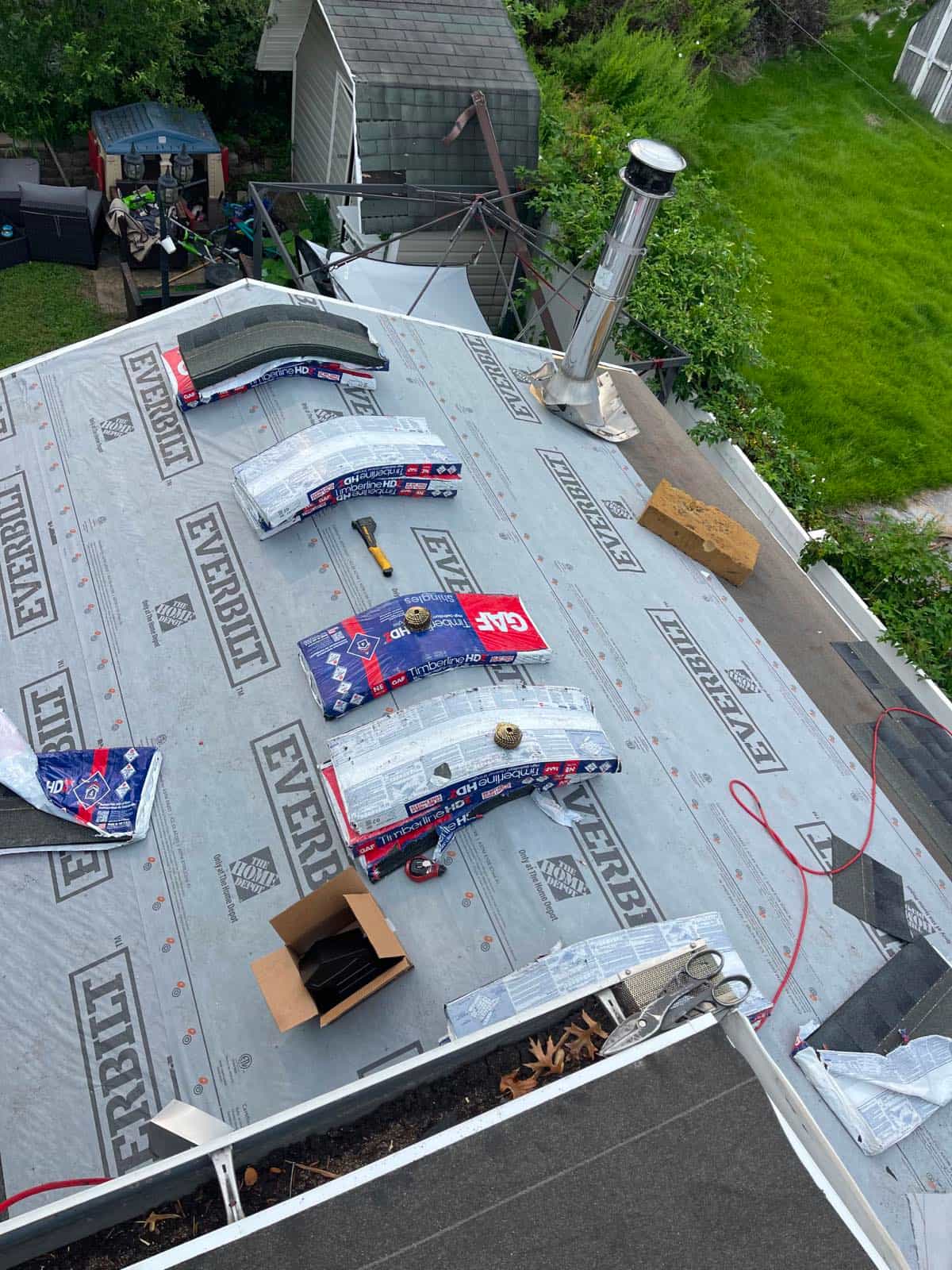
Yes, you can replace a roof in winter in New Jersey, and the shingle makers publish how. At about 40°F and below, the factory seal strip may not bond the shingles on its own and cold shingles can crack, so the job switches to a cold-weather procedure: warm storage, careful handling, hand-sealing with roofing cement, and a deck clear of snow, frost and ice.
Temperature is usually not what ends a winter work day. Snow on the deck, morning frost, wind before the shingles seal and a short December day do. On December 21 the sun is up in Newark for about nine hours and fifteen minutes, and everything torn off that morning has to be shingled by dark.
This guide covers the cold-weather instructions GAF and Owens Corning publish, GAF sheets for ice barrier and synthetic underlayment, and what a winter quote should say. It is for a North Jersey homeowner deciding between replacing now and waiting for spring.
Can you replace a roof in winter? Yes, and 40°F is where the maker's rules take over
Each shingle maker publishes its own cold-weather instructions, and GAF and Owens Corning both build theirs around 40°F. GAF recommends installing at 40°F (4°C) or above and allows installation below that when the contractor follows its cold-weather precautions. Owens Corning's bulletin TB-10022497-A, printed April 2026, applies when air and surface temperatures are at or below 40°F. Neither names a temperature below which installation is forbidden. Both set a procedure.
CertainTeed's public cold-weather page prints no shingle minimum; it says every product has a minimum installation temperature and to respect it. The instructions for the shingle going on your roof govern, so ask a contractor which maker's cold-weather sheet they will follow, not whether they "do winter work."
Our page on the architectural shingle roof system answers the can-it-be-done question in a paragraph. This post is the detail behind it.
Seal strips and hand-sealing: why a cold roof starts out unsealed
An asphalt shingle carries a factory strip of heat-activated sealant that sun and warmth soften so each course bonds to the one below. Owens Corning says the timing depends on location, roof slope, which way the roof faces the sun and the average daily temperature during and after installation, and that shingles installed in the cold may not seal until warmer temperatures arrive. GAF says unsealed shingles are vulnerable to wind uplift and water getting in.
Until the strip bonds, what holds a shingle down in a gust is its nails and any cement put under it by hand. That is the whole reason for hand-sealing.
GAF's bulletin TAB-R-114 says a shingle that fails to seal for lack of heat is not a manufacturing defect, and its Timberline instructions add that shingles damaged by wind before they seal, or whose sealant gets dirty, may never seal. So a tab that lifts on a January roof is a question of whether the cold-weather procedure was followed.
Once the weather warms and sun reaches the roof, GAF says the shingles finish sealing naturally. The makers describe the hand-sealing a little differently:
- GAF (Timberline instructions): shingles applied during prolonged cold periods must be hand sealed with four quarter-sized dabs on the back of the shingle, 1 inch and 13 inches in from each side and 1 inch up from the bottom. The cement is asphalt plastic cement meeting ASTM D4586 Type I or II, in a layer under 1/8 inch.
- Owens Corning (TB-10022497-A): hand-seal every shingle along the entire roof perimeter, with four 1-inch dabs of ASTM D4586 cement on laminate shingles and two under each tab on three-tab shingles, and gap field shingle end joints no more than 1/16 inch.
- ARMA, the asphalt roofing manufacturers' trade association, says hand-sealing adds wind protection in very cold weather, and that roof traffic may break a cold sealant bond.
- GAF and Owens Corning both warn that too much cement can blister the shingles.
Ice barrier membrane in the cold: what GAF's sheets require
The self-adhering membrane at the eaves and valleys is the layer most sensitive to cold, and GAF publishes two numbers that do not quite agree. Its StormGuard installation sheet says to apply it on a dry deck with the air between 45°F and 120°F. Bulletin TAB-R-152 (2021) gives 40°F to 120°F and allows installation below 40°F with precautions. Plan on the stricter number. The precautions:
- The deck is clean and dry, with no ice, frost, dew, moisture, dust or dirt.
- Rolls and adhesives are stored at least overnight at 55°F or warmer and come out of storage only as they are installed.
- When the air is below 40°F, the membrane itself must be at least 45°F when it goes down.
- Rolls are pre-cut to 10 to 20 foot lengths and back-nailed every 18 inches along the top edge so the sheet cannot slide.
- The membrane is pressed down and the laps are hand-rolled (a hot air gun is allowed at the laps). If it is not sticking, installation stops.
What a cold membrane, cold shingles and cold nail guns do
TAB-R-152 also lists what goes wrong with a membrane laid too cold: an unadhered sheet can move underfoot and cause a fall, unsealed laps let water and dirt in (a dirty lap may never seal), and a too-cold membrane can wrinkle into what GAF calls mole runs that show through the shingles and can open laps to leaks.
If the rest of the deck gets a synthetic underlayment such as GAF's FeltBuster, its sheet (6/19) gives no air-temperature range, but it requires a dry deck, calls the product water resistant and not waterproof, says not to use it as a temporary roof, and notes that its 90-day exposure rating is about UV, not how long it withstands water, snow or wind. Underlayment left bare through a snowstorm is not a roof.
On the shingles, GAF says that below 40°F they lose flexibility and may crack. It advises storing bundles at 70°F for at least 24 hours before installation, carrying up small amounts so they do not cool off, never throwing or dropping them, and flattening stiffened bundles by hand. ARMA adds that cold shingles hold the shape of the stack and must lie flat before nailing, or the nail may break through the surface.
Cold shows up in the tools too. GAF says air compressors struggle to hold pressure, so crews should check it often and keep pneumatic tools stored warm and lubricated; an under-driven nail can puncture the shingle above and an over-driven one can cut the shingle below. GAF also suggests spreading the job over several days and replacing the roof in sections to catch the warmest hours.
What actually stops a winter roof job
The 40°F line triggers a procedure. These conditions should end a work day or push it back:
- Snow, frost or ice on the deck. GAF says the deck must be free of all three, that a snow forecast can delay the job and require snow removal, and that morning frost pushes start times later.
- Wind before the shingles seal. Until warm sun activates the strip, hand-sealing and nails carry the load, and a shingle damaged by wind before it seals may never seal.
- Daylight. The U.S. Naval Observatory lists Newark sunrise at 7:17 a.m. and sunset at 4:32 p.m. on December 21, 2026, and GAF notes crews must wrap up before dark.
- A tear-off bigger than the day. Each section opened in the morning has to be shingled by dark; GAF says underlayment is not a temporary roof.
- A membrane or lap that will not stick. TAB-R-152 says to stop.
Planned versus forced: when winter makes sense and when a repair can hold until spring
GAF's case for winter work is short: demand tends to be lower in the cold, so contractors may be more available, and dealing with the roof now avoids the damage that waiting can bring. The cost is the weather-gated schedule above. For a planned roof replacement on a roof that is not leaking, a mild stretch in late fall or waiting for spring are both reasonable.
The forced case starts with stopping the water. After a storm, emergency roof repair covers tarping. If the problem traces to one pipe boot, valley or chimney detail, roof leak repair is usually the honest winter answer, with replacement decided in spring.
- Replacing now is reasonable when shingles are failing across most of the roof, decking is wet or soft, or storm damage is widespread.
- A repair that holds until spring is reasonable when the leak traces to one detail and nothing structural is wet.
What a winter roof quote and contract should say
Our guide to reading a roofing quote covers the standard lines. GAF states that cool-weather installation does not affect its warranty if all of its application instructions are followed, including cool-weather provisions such as hand-sealing. That is a condition, so a winter quote should say how it will be met:
- Which maker's cold-weather instructions apply to your specific shingle.
- Hand-sealing: the cement (ASTM D4586), which shingles get it and how many dabs.
- How each day ends: every section torn off is shingled before the crew leaves.
- Weather days: who calls a stop for snow, frost or wind, and what happens to the schedule.
- Snow on the deck: whether clearing it is included.
- A spring check after the first warm stretch for shingles that did not seal.
Permits, inspections and who to call
Permit rules do not change with the season. Whether a roof covering replacement on a detached one- or two-family house needs a permit, and when decking or framing work does, is laid out in our post on the number one cause of roof leaks. If your job needs one, ask who schedules the inspection and what a snow day does to that date. This is general information, not legal advice.
We replace and repair roofs across Bergen, Passaic, Essex and Hudson counties. To have a roof looked at before you decide, call (201) 275-9185. We are registered with the State of New Jersey as a home improvement contractor, HIC reg.# 13VH13970900, and if the honest answer is a repair now and a replacement in April, that is what we will tell you.
Sources (read October 20, 2026)
Manufacturers revise these sheets, so check the current instructions for your shingle.
- GAF, Cool Weather Roofing: Must-Know Tips for Installing Shingles in Cool Temperatures, October 10, 2025: https://www.gaf.com/en-us/blog/residential-roofing/cool-weather-roofing-must-know-tips-for-installing-shingles-in-cool-temperatures-c1f35062-b49f-45ef-b2bb-fbc0304d6b69
- GAF, TAB-R-114 Hand-Sealing Shingles, R2 April 17, 2024: https://www.gaf.com/en-us/document-library/documents/technical-bulletins-&-notes/r-114-hand-sealing-shingles.pdf
- GAF, TAB-R-152 Cool Weather Installation of StormGuard and WeatherWatch Leak Barriers, February 1, 2021: https://www.gaf.com/en-us/document-library/documents/technical-bulletins-&-notes/r---152-cool-weather-installation-of-stormguard-and-weatherwatch.pdf
- GAF, StormGuard Film-Surfaced Leak Barrier Installation Instructions: https://www.gaf.com/en-us/document-library/documents/installation-instructions-&-guides/stormguard-film-surfaced-leak-barrier-installation-instructions-trilingual-resul192.pdf
- GAF, FeltBuster High-Traction Synthetic Roofing Felt Installation Instructions, 6/19: https://www.gaf.com/en-us/document-library/documents/installation-instructions-&-guides/installation_instructions__feltbuster.pdf
- GAF, Timberline Installation Instructions, RESTL622 (4/23): https://www.gaf.com/en-us/document-library/documents/installation-instructions-&-guides/timberline-layerlock-installation-instructions-trilingual-restl622.pdf
- Owens Corning, Technical Bulletin TB-10022497-A, Cold Weather Shingle Installation, April 2026: https://www.owenscorning.com/dms/10022497
- ARMA, Recommendations for Installation of Asphalt Roofing Shingles in Cold Weather, March 28, 2022: https://asphaltroofing.org/recommendations-for-installation-of-asphalt-roofing-shingles-in-cold-weather/
- CertainTeed, Cold Weather Installations: https://www.certainteed.com/inspiration/how-tos/cold-weather-installations-how-certainteed-makes-them-easier
- U.S. Naval Observatory, sun data for Newark, NJ, December 21, 2026: https://aa.usno.navy.mil/api/rstt/oneday?date=2026-12-21&coords=40.7357,-74.1724&tz=-5