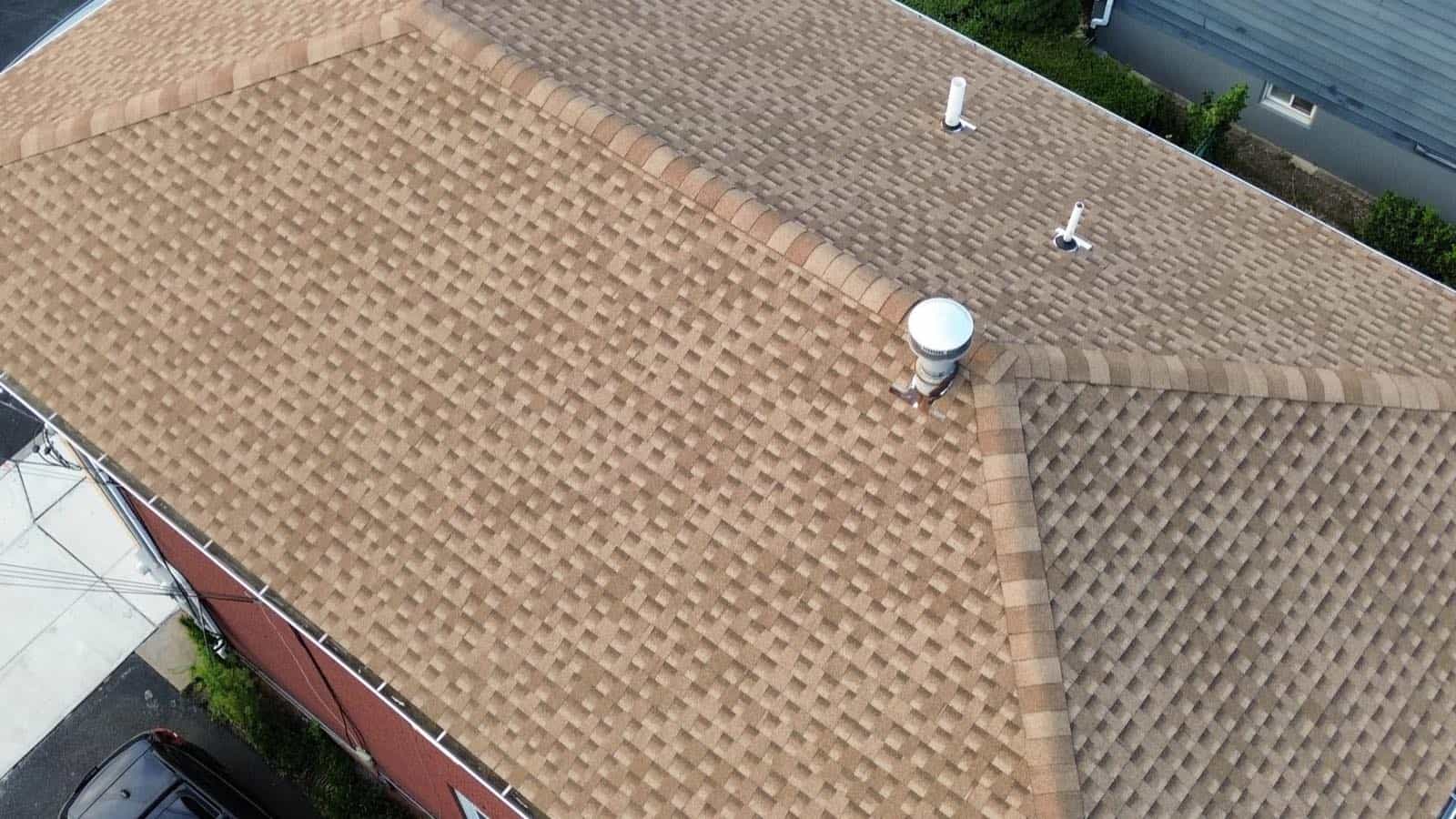
An ice dam is a ridge of ice along the lower edge of a roof that stops melting snow from draining off. Water backs up behind it, works under the shingles and shows up inside as a stain on a ceiling or wall. In North Jersey it is mostly a freeze-thaw problem, not a deep-cold one: NOAA's 1991 to 2020 normals put Newark's average January temperature at 32.8 degrees, and on about half of January's days the air both drops to freezing and climbs above it.
Below: why they form, the warning signs, prevention, what New Jersey's code requires at the eaves, safe removal and what insurance generally covers. If you want a dam gone now, that is our ice dam removal service; this page explains the problem. We are roofers, and nothing here is insurance, legal or engineering advice.
What an ice dam is, and why the water ends up inside
Owens Corning describes an ice dam as a wall of ice at the roof edge that forms when melting snow keeps thawing over warmer parts of the roof and refreezing at the colder eaves. The real problem is the water it holds back. Shingles are lapped so water running downhill passes from course to course and off the edge; water sitting still behind a dam creeps up under the laps instead. GAF traces where it goes next: under the shingles and into ceilings, walls and insulation.
FEMA's Snow Load Safety Guide adds the structural side: ice dams stop snow from sliding off and pile an unbalanced load at the eave, and water getting into the building is the second, and potentially larger, problem.
Why ice dams form: heat from the house, cold at the eave
University of Minnesota Extension sets out the conditions: snow on the roof, a higher part of the roof surface above 32 degrees, a lower part below it, and outside air cold enough to keep the edge frozen. Meltwater from the upper roof runs down, freezes at the edge and builds the dam, and every later melt adds water behind it.
The heat comes from the house. In many homes, the Extension says, air leaking through the ceiling into the attic is the major route, through gaps such as those around light fixtures. It also names exhaust vents that end near the roof, chimneys, leaky attic ductwork and knee wall spaces.
The eave stays cold because nothing heated sits under it. The overhang hangs outside the exterior wall, in outdoor air. FEMA's guide shows meltwater freezing at the eave and the problem growing as the dam does, and notes that a well-ventilated attic runs close to the outdoor temperature, so the house does not melt roof snow from below.
North Jersey's winters run on freeze-thaw: what NOAA's normals show
FEMA's guide names the pattern: temperatures fluctuating above and below freezing melt snow that refreezes into ice and ice dams. NOAA's 1991 to 2020 climate normals show how often that happens here.
The number that matters is the crossings. NOAA gives the average days with a low at or below 32 and the days with a high at or below 32. The difference is days that go both below and above freezing: about 15.6 of January's 31 at Newark, and about 58 from December through March. Teterboro comes to about 64, Essex Fells about 73 and Wanaque Raymond Dam about 76. That is our arithmetic from NOAA's counts, measured in the air rather than on a roof, and only about 7 January days at Newark stay frozen all day. How much snow arrives is in how much snow North Jersey gets.
January's average temperature at the five stations:
- Newark Liberty Airport: 32.8°F (average high 40.0, low 25.5).
- Teterboro Airport, Bergen County: 32.8°F.
- Harrison, Hudson County: 32.1°F.
- Essex Fells, Essex County, about 350 feet up: 29.9°F.
- Wanaque Raymond Dam, Passaic County, about 245 feet up: 28.8°F.
Icicles or an ice dam? The warning signs outside and in
Icicles alone do not prove an ice dam; they are meltwater that froze on the way off. Owens Corning says icicles may signal potential ice dams, and GAF says not to ignore the ones that form after a snowstorm. The difference is ice that holds water back.
Keep people out from under the drip line. FEMA warns that an icicle falling even from a short height can cause damage or injury. Drips off a dammed eave also refreeze on the steps below; clearing and salting walks is covered on our snow removal page.
Look for:
- A ridge of ice along the eave or filling the gutter.
- Heavy icicles on one stretch of roof, often where heat escapes, such as above a bath fan or beside a chimney.
- Snow gone from the upper roof while the edge stays loaded.
- Gutters sagging or pulling away; GAF notes large dams are extremely heavy.
- Inside, stains on ceilings or walls near the exterior walls during a thaw, or damp attic insulation near the eaves, which ENERGY STAR treats as a sign of a leaky roof.
Prevention, in the order that matters: air sealing, insulation, ventilation
Minnesota Extension calls sealing the ceiling against air leaks the first step, insulation the second, and ventilation a help that needs only small amounts once heat loss is under control. ENERGY STAR says air sealing combined with attic insulation can help alleviate ice dams.
1. Air sealing. ENERGY STAR lists the usual attic leaks: the hatch, wiring and plumbing holes, dropped soffits, recessed lights, the furnace flue or duct chase, and knee walls. It also flags hazards: vermiculite may contain asbestos and should be tested before it is disturbed, insulation stays at least 1 inch from metal flues and 2 inches from masonry chimneys, and sealing can make a gas or oil appliance back-draft, so a contractor should test those appliances before and after.
2. Insulation, especially over the eave. For new homes, the 2024 energy code New Jersey enforces lists R-49 attic insulation in both North Jersey climate zones (5A for Bergen and Passaic, 4A for Essex and Hudson). R-38 can stand in only where it runs at full, uncompressed height over the wall at the eaves, and vented attics with loose-fill or batt insulation need an eave baffle that keeps the soffit vent open. The state's rulemaking routes existing buildings to its Rehabilitation Subcode, so for an older house those numbers are a yardstick, not an order.
3. Ventilation. The 2024 International Residential Code generally requires a net free vent area of 1/150 of the vented attic area, or 1/300 when 40 to 50 percent of it sits within 3 feet of the ridge and the rest low, plus at least a 1-inch air space between insulation and sheathing at eave vents. GAF puts intake at or near the soffits and exhaust at or near the ridge. Minnesota Extension does not recommend powered attic ventilators in its climate, citing moisture problems and negative pressure in the house.
GAF notes that clogged gutters trap water and encourage dams, so fall gutter cleaning and roof raking help, but neither changes the heat; a dam that returns to the same spot every winter usually points to heat escaping there.
The ice barrier at the eave: what New Jersey's code actually requires
An ice barrier, often sold as ice and water shield, is the layer under the shingles at the eave that keeps backed-up water off the roof deck. It does not stop a dam from forming; it limits where the water goes.
New Jersey adopted the 2024 International Residential Code as its one- and two-family dwelling subcode effective August 17, 2026. Its Section R905.1.2 calls for at least two layers of underlayment cemented together or a self-adhering polymer-modified bitumen sheet, from the lowest roof edges to a point at least 24 inches inside the exterior wall line, and at least 36 inches up the slope on roofs of 8 in 12 or steeper. Detached accessory structures with no conditioned floor area are exempt.
Where it is required is the New Jersey part. The model code ties the barrier to areas with a history of ice forming along the eaves. New Jersey's adopting rule, N.J.A.C. 5:23-3.21(c)8ii, replaces that with areas where the average daily January temperature is 25°F or less, and DCA Bulletin 07-3 (May 2007, revised June 2015) says that area is Sussex County. The five NOAA stations above run from 28.8 to 32.8 degrees.
So in Bergen, Passaic, Essex and Hudson the membrane is a choice, even though GAF says most codes require leak barriers where ice damming is a threat. We include it on our roof replacements. On any bid, look for it as a written line with its extent, since 24 inches inside the wall line covers far more than an edge strip on a deep overhang; how to read a roofing quote covers the rest.
Removing an ice dam: what is safe and what damages the roof
FEMA says roof snow removal can be done from the ground, removing the risk to people on a hazardous roof. OSHA warns that snow hides skylights and that overhead power lines are an electrical hazard during snow work.
What is reasonable from the ground, and what damages roofs:
- Reasonable: a roof rake on a low eave. GAF's advice is for single-story homes, with light pressure. FEMA prefers a non-metallic rake, says to leave at least 2 inches of snow, and warns roof snow can slide at any moment.
- Reasonable: leaving gutter ice alone. GAF says waiting for it to melt may be best, because breaking it up easily damages the gutter or roof.
- Damaging: chopping or chipping. FEMA says not to use sharp tools such as picks. GAF says asphalt shingles lose flexibility and may crack below 40°F, and cracked shingles can leak and affect the warranty. An ice dam only exists when it is colder than that.
- Damaging: rock salt. Travelers' risk-control guidance says it can damage the roof, and Penn State Extension calls rock salt the de-icer most harmful to plants, and the runoff lands in the beds below.
The stopgap, and how a professional removes a dam
The stopgap. Travelers describes calcium chloride in a nylon stocking laid across the dam to melt a channel, with tarps over the shrubs; Penn State notes calcium chloride can also harm plants. Minnesota Extension describes opening a channel with a hose and tap water on a warm day, and says the channel becomes ineffective within days. Either way, a channel relieves pressure; it does not remove the dam.
How a professional does it. GAF says roofing contractors use a steamer to melt the dam without damaging the roof, and steam is our method. Our ice dam removal page covers the service.
Does homeowners insurance cover ice dams in New Jersey?
Generally the sudden water damage, subject to your deductible and your policy's wording, and generally not wear or slow leaks. No roofer can promise what a carrier decides.
New Jersey's Department of Banking and Insurance said in a December 2014 winter advisory that standard policies generally cover collapse caused by the weight of ice and snow, and ice dam leakage, and that deductibles apply. DOBI's homeowners policy summary lists sudden and accidental water damage and the weight of ice, snow or sleet as covered, and lists wear and tear, rotting and maintenance, continuous and repeated seepage, mold unless it results from a covered loss, and flooding as not covered. A stain that has returned for several winters can run into those exclusions, and DOBI's current consumer guide also names neglect.
Whether a policy pays to remove the ice itself, as opposed to repairing the damage, is not something these summaries answer, so ask your insurer before the work. DOBI's Insuring Your Home guide says to report a loss as soon as possible, make temporary repairs to protect the property from further damage, and save all receipts. It adds that you are not required to use the company's recommended contractor, and that an unresolved dispute can go to DOBI at 609-292-7272.
Photograph the ceiling, attic and eave before repairs; our storm damage claim documentation page covers what to record.
When to call a roofer, and what to check after the thaw
Call when water is coming in, when the dam runs along a long stretch of eave or a gutter is pulling away, when the roof is too high or steep to rake from the ground, or when dams return to the same place every winter. If the worry is weight, such as a sagging ceiling, creaking, or doors or windows that can no longer be opened or closed, call a structural engineer first; how much snow a roof can hold covers those signs.
A roof inspection catches what the ground cannot show. Call (201) 275-9185, HIC reg.# 13VH13970900, and describe what you see. If the fix is in the attic rather than on the roof, we will tell you so.
FEMA recommends inspecting the roofing once the snow comes off. After the thaw, check for:
- New or larger ceiling stains near the exterior walls.
- Lifted, cracked or missing shingles along the eave.
- Bent gutters and downspouts pulled away from the wall.
- Damp insulation or dark, wet decking near the eaves, if you can reach the attic safely.
Sources (read October 21, 2026)
The figures above come from these sources.
- NJ Department of Community Affairs, Bulletin 07-3, Ice Dam Membrane/Ice Barrier, issued May 2007, revised June 2015: https://www.nj.gov/dca/codes/publications/pdf_bulletins/b_07_3.pdf
- N.J.A.C. 5:23-3.21, One- and two-family dwelling subcode (adopts the IRC/2024; (c)8ii amends Section R905.1.2), and 5:23-3.18, Energy subcode (adopts the IECC/2024), text through the New Jersey Register of August 17, 2026: https://www.nj.gov/dca/codes/codreg/pdf_regs/njac_5_23_3.pdf
- NJ Department of Community Affairs, notice of adoption of the 2024 model codes, 58 N.J.R. 1898(a), R.2026 d.086, effective August 17, 2026: https://www.nj.gov/dca/codes/codreg/pdf_rule_adoptions/model_codes_2024_adopt.pdf
- NJ Department of Community Affairs, notice of proposal, 57 N.J.R. 2354(a), October 20, 2025 (the IECC 2021-to-2024 table, ceiling R-60 to R-49 in Zones 4 and 5; existing buildings and the Rehabilitation Subcode, item 104): https://www.nj.gov/dca/codes/codreg/pdf_rule_proposals/2024_prop_p1.pdf
- International Code Council, 2024 International Residential Code, Chapter 9, Section R905.1.2: https://codes.iccsafe.org/content/IRC2024V2.0/chapter-9-roof-assemblies
- International Code Council, 2024 International Residential Code, Chapter 8, Sections R806.1 to R806.3: https://codes.iccsafe.org/content/IRC2024V2.0/chapter-8-roof-ceiling-construction
- International Code Council, 2024 International Energy Conservation Code, Table R301.1, Table R402.1.3 and Sections R402.2.1 and R402.2.4: https://codes.iccsafe.org/content/IECC2024P1/chapter-3-re-general-requirements and https://codes.iccsafe.org/content/IECC2024P1/chapter-4-re-residential-energy-efficiency
- NOAA National Centers for Environmental Information, U.S. Climate Normals 1991-2020, monthly normals for Newark Liberty Intl AP (USW00014734), Teterboro AP (USW00094741), Harrison (USC00283704), Essex Fells Service Bldg (USC00282768) and Wanaque Raymond Dam (USC00289187): https://www.ncei.noaa.gov/access/services/data/v1?dataset=normals-monthly-1991-2020&stations=USW00014734,USW00094741,USC00283704,USC00282768,USC00289187&dataTypes=MLY-TAVG-NORMAL,MLY-TMAX-NORMAL,MLY-TMIN-NORMAL,MLY-TMIN-AVGNDS-LSTH032,MLY-TMAX-AVGNDS-LSTH032&format=csv&units=standard&includeStationName=true
- FEMA, Snow Load Safety Guide (FEMA P-957), January 2013: https://www.wbdg.org/FFC/DHS/femap957.pdf
- OSHA, Winter Weather: Hazards/Precautions: https://www.osha.gov/winter-weather/hazards
- University of Minnesota Extension, Dealing with and preventing ice dams, reviewed 2022: https://extension.umn.edu/protecting-home-rain-and-ice/dealing-and-preventing-ice-dams
- ENERGY STAR, Attic Air Sealing Project: https://www.energystar.gov/saveathome/seal_insulate/attic-air-sealing-project
- GAF, What Is an Ice Dam? Preventing Winter Roof Damage, Karen L. Edwards, February 25, 2021: https://www.gaf.com/en-us/blog/your-home/what-is-an-ice-dam-preventing-winter-roof-damage-976c712c-d39c-4e30-9978-1e31f5073099
- GAF, 4 Ice Dam Prevention Tips for Winter, Dawn Killough, January 25, 2022: https://www.gaf.com/en-us/blog/your-home/4-ice-dam-prevention-tips-for-winter-1edd83b5-ba0c-48ef-bdd1-ff7eab240199
- GAF, Cool Weather Roofing: Must-Know Tips for Installing Shingles in Cool Temperatures, Karen L. Edwards, October 10, 2025: https://www.gaf.com/en-us/blog/residential-roofing/cool-weather-roofing-must-know-tips-for-installing-shingles-in-cool-temperatures-c1f35062-b49f-45ef-b2bb-fbc0304d6b69
- Owens Corning Roofing, How to Avoid Roof Ice Dams, November 12, 2024: https://www.owenscorning.com/en-us/roofing/blog/roof-ice-dams
- Travelers, How to Identify and Help Remove an Ice Dam: https://www.travelers.com/resources/weather/winter-storms/how-to-prevent-and-remove-ice-dams
- Penn State Extension, Justin Mansberger, Watershed-friendly Deicing, updated April 15, 2024: https://extension.psu.edu/watershed-friendly-deicing
- NJ Department of Banking and Insurance, Tips for Holiday Mishaps and Coverage Alerts When Facing Winter Issues, December 22, 2014: https://nj.gov/dobi/pressreleases/pr141222.html
- NJ Department of Banking and Insurance, Homeowners Insurance policy summary (Exhibit A), April 2015: https://nj.gov/dobi/division_consumers/insurance/homeownersummaries/homeowners.pdf
- NJ Department of Banking and Insurance, Insuring Your Home: A consumer guide to Homeowners, Renters and Condominium Insurance, 2026 edition: https://www.nj.gov/dobi/division_consumers/pdf/insuringyourhome.pdf