For outdoor Christmas lights on a roofline, C9 bulbs are the size that reads from the street, C7 bulbs suit shorter runs around a porch or walkway, mini lights fill in shrubs and wreaths, and icicle sets hang from a straight gutter edge. That is a starting point, not a rule. The rest of the decision is printed on the box: LED or incandescent, which white, whether the set is marked for outdoor use, and how much length the house really needs.
This guide is for a North Jersey homeowner buying sets for the roofline, the shrubs and the porch of a colonial, Cape or ranch. It covers how the four styles differ, what the U.S. Department of Energy and ENERGY STAR say about LED sets, how to read the testing-lab label, and how to measure from the ground before you buy. Clips, fasteners, cords, outlet loads and taking lights down are covered in our separate guide to hanging lights without damaging the roof, so they are not repeated here.
Choosing outdoor Christmas lights: start with the house, not the box
A string of lights is judged from the sidewalk, not from a ladder. Stand at the curb and note where your eye lands: the long gutter line, the gable peaks, the front door, the porch columns, the foundation shrubs. Each is a different kind of run, and each may want a different set.
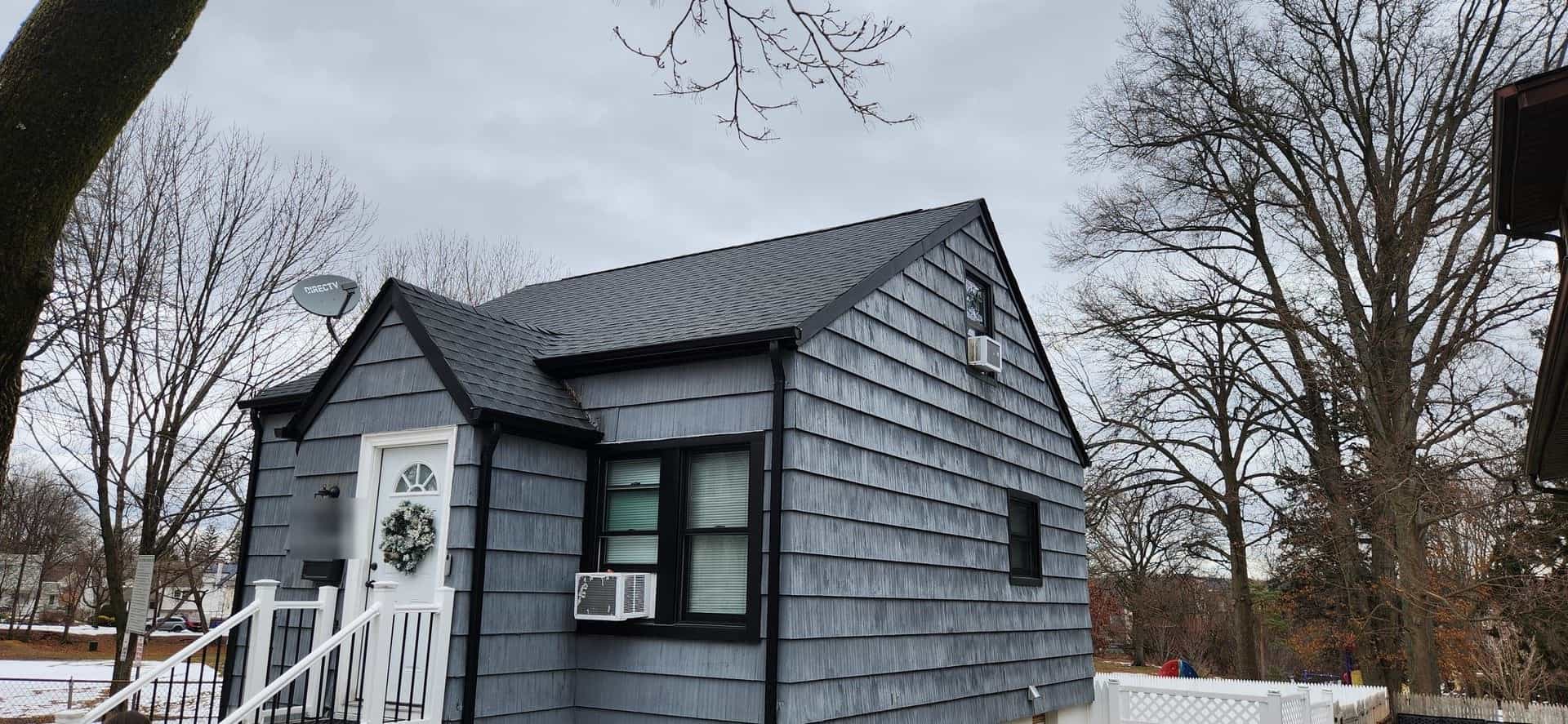
A two-story colonial puts most of its visible length into one gutter line plus the gable peaks, so the bulb on that line is the choice that matters most. A ranch has a low roofline close to eye level, where large bulbs can look heavy. A Cape often keeps its character in the dormers and the porch, where smaller sets tracing the edges can carry more of the look than one bold run.
Pick the runs first, then the bulbs. A short list such as roofline, peaks, porch, door and two shrubs tells you which sets to buy and how many of each.
C9 vs C7, mini and icicle lights: what each one is
C9 and C7 are the same bulb shape in two sizes. GE Lighting's bulb guide explains that the letter in a bulb code is the shape, with C for candle, and the number is the diameter at the widest point in eighths of an inch. A C7 is therefore 7/8 inch across and a C9 is 9/8, or about 1 1/8, inches.
The bases differ too. C7 holiday bulbs use the E12 candelabra screw base and C9 bulbs the larger E17 intermediate base, so a C9 bulb will not screw into a C7 socket, or the reverse. When you buy replacements, match the base and shape printed on the set, not just the word Christmas on the bag.
C9 is the roofline size. Lighting retailers' guides describe C9 as the bulb most commonly used for lining roofs, and C7 as the choice for smaller displays such as porches, walkways and wrapped columns.
Mini lights are small bulbs on thin wire. Their strength is detail: shrubs, wreaths, garland, window frames and railings. On a roofline they tend to read from the street as a fine dotted line rather than a bold one.
Icicle lights hang drops of different lengths from one main line. They suit a straight, unbroken gutter or eave where the drops can hang free. A roofline broken up by dormers, valleys and downspouts gives the drops something to snag on.
One practical point: a run of large bulbs on heavy wire, or a long icicle set, weighs more than a mini string, and a gutter that already sags or has loose hangers will show it first. Settle that with gutter repair before lights go up. If your gutters have gutter guards, check what the guard maker allows before choosing a set that depends on gripping the gutter lip.
LED or incandescent outside
The Department of Energy says LED strands are sturdier, last longer and consume 70 percent less energy than conventional incandescent strands, and are significantly less likely to burn out or break. ENERGY STAR's figure is higher, about 92 percent less energy, but it applies to strings that carry the ENERGY STAR certification, not to every LED set on the shelf. The two numbers measure different things.
ENERGY STAR also says certified LED strings can last up to 10 times longer than incandescent strands, carry a manufacturer warranty of at least three years, and are cool to the touch, which it says reduces the risk of fire. Less heat matters on a house, where a bulb often sits against a gutter, a wreath or dry garland.
Do not mix LED and incandescent sets in one continuous run. They differ in brightness and in the tone of the white, and the join shows from the street. Keep each run to one product, and follow whatever limit the package gives for connecting sets end to end. The power side, including how many sets to connect and where to plug in, is in the guide to hanging lights without damaging the roof.
Warm white, cool white or multicolor
ENERGY STAR describes the color of light on the Kelvin scale: a lower number means warmer, more yellow light, and a higher number cooler, bluer light. Its bulb chart runs from about 2200K to 6500K, labelling the warm end soft white or warm white, the middle neutral white or cool white, and the top daylight.
Holiday sets usually print only warm white or cool white, with no number. Warm white sits next to brick, stone and wood-tone siding without fighting it, which is why it is a common roofline choice. Cool white reads crisp against white or gray vinyl siding and a dark roof.
Sets bought in different years rarely match. Warm white is a range, not a point, and makers place it differently. Buy every set for one run at the same time and keep a spare of the same product. To add to an older display, compare last year's strand with the new one at dusk before you commit.
For multicolor, put the color changes between runs, not in the middle of one. White on the roofline and color on the shrubs reads as a plan; one colored stretch in a white gutter line reads as a mistake.
Read the box: the outdoor label and the testing-lab mark
The U.S. Consumer Product Safety Commission tells shoppers to use only lights tested for safety by a nationally recognized testing laboratory, and to check outdoor lights for labels showing they have been certified for outdoor use.
UL is one such laboratory, and its bulletin on decorative lighting strings is specific: indoor-use-only strings carry UL's green holographic label, and indoor-or-outdoor strings carry its red one. UL evaluates them to UL/ANSI 588, the Standard for Safety of Seasonal and Holiday Decorative Lighting. If the package shows a different laboratory's mark, look for that laboratory's own outdoor wording. ENERGY STAR adds that certified strings labeled for outdoor use go through weathering tests.
An indoor-only set stays indoors, even when it is exactly the bulb you wanted for the roofline. Before any set goes up, CPSC says to check it, new or old, for broken or cracked sockets, frayed or bare wires and loose connections, and to throw out damaged sets.
Measure from the ground before you buy
Nobody should climb to measure a roofline. Measure from the ground and write each run down separately:
- Gutter and eave lines: run a long tape along the wall under each line, or take the length from your survey or plot plan. Note every inside and outside corner.
- Gable and dormer edges: the sloped edge is longer than the wall under it, so allow extra instead of using the wall width.
- The drop to the plug: measure from the end of each run to the existing outdoor outlet it will use, along a path that does not cross a walkway, a step or a door.
- The set against the run: most packages print the set length and the spacing between bulbs. A set that falls short leaves a dark stretch at a corner.
- The connection limit: if one run needs more sets than the package allows end to end, split it into two runs fed from different existing outlets.
Shrubs, porches, railings and wreaths
Foundation shrubs and small evergreens are where mini lights and net lights belong: a net drapes over a shrub as a grid, and a mini string wraps a trunk or follows the branch line. C7 sets work on a porch rail or along a fence, where the larger bulb still reads but the run is short. Wreaths and garland with built-in lights need the same outdoor label as everything else outside.
Keep cords out of walkways. Route them along the house wall or the edge of the planting bed, never across a step. If lit garland or greenery is also going on a mantel, read the fireplace checks before the first fire of the holidays first.
Storing sets, and when a crew makes more sense
Wind each set on a reel or around a stiff piece of cardboard so the wire does not kink, put the sets in a bin, and label each by where it goes: front gutter, west gable, porch rail. Keep spare bulbs with the set, and keep the package panel or a photo of it showing the base, color name and connection limit, so next year's replacement actually matches.
If measuring, matching and ladders add up to more than you want to take on, a crew can hang your sets or supply its own. The Christmas light installation page lists what is included, how takedown and storage work, and the planning ranges. We plug lights into your existing outdoor outlets only; we do not add outlets, circuits or wiring. We work across Bergen, Passaic, Essex and Hudson counties, and you can reach us at (201) 275-9185, HIC reg.# 13VH13970900.
Sources (read October 20, 2026)
Every number and rule above that is not a matter of taste comes from one of these.
- GE Lighting, A Guide to Light Bulb Sizes, Types, Shapes, and Codes, April 22, 2022: https://www.gelighting.com/inform/guide-light-bulb-sizes-types-shapes-and-codes
- 1000Bulbs, C7 vs C9 Christmas Lights: https://blog.1000bulbs.com/home/c7-vs-c9-christmas-lights
- U.S. Department of Energy, How Do Holiday Lights Work?, December 16, 2015: https://www.energy.gov/articles/how-do-holiday-lights-work
- ENERGY STAR, Decorative Light Strings: https://www.energystar.gov/products/decorative_light_strings
- ENERGY STAR, LED Bulbs Made Easy (light bulb purchasing guide), March 16, 2020: https://www.energystar.gov/sites/default/files/asset/document/Light%20Bulb%20Purchasing%20Guide_16Mar2020.pdf
- UL Solutions, Decorative Lighting Strings bulletin, July 24, 2017, updated May 29, 2025: https://ul.com/news/bulletin-decorative-lighting-strings
- U.S. Consumer Product Safety Commission, Put Safety at the Top of Your List When Decorating this Holiday Season, December 6, 2017: https://www.cpsc.gov/Newsroom/News-Releases/2018/Put-Safety-at-the-Top-of-Your-List-When-Decorating-this-Holiday-Season