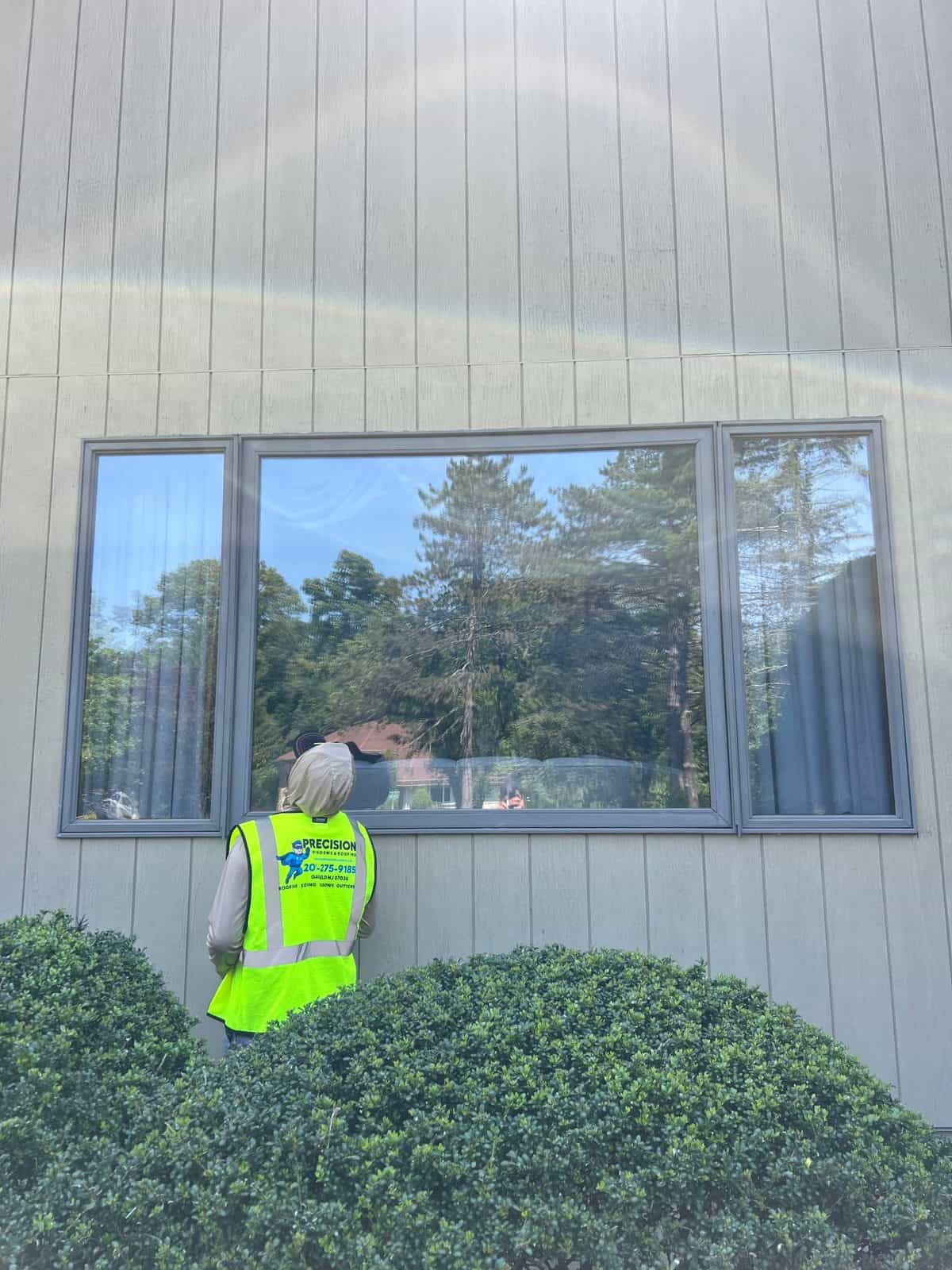
Picture Window Framing
Large fixed picture windows that frame your view.
Picture Window Framing
Showcase your view with large, fixed picture windows. We specialize in framing and installing expansive glass units that serve as living art for your home.
Picture windows look simple from the outside — one big pane, one big view. The engineering behind them is anything but. Once a fixed IGU passes about 30 square feet, you're dealing with weight that exceeds what two installers can handle, glass deflection that changes the spacer requirements, wind-load math under ASCE 7-22 that drives glass thickness, and mulled-assembly framing details that have to transfer load to the rough opening without binding the operable units flanking them. We frame and install picture windows across NJ — from 5x6 living-room panels in Bergen County colonials to 8x10 lake-view units in Sussex and ocean-facing assemblies in Mantoloking and Spring Lake that have to survive sustained 130 mph wind events.
The mistake most contractors make is sizing picture windows like they're scaled-up casements. They're not. A 6x8 fixed unit is roughly 100 pounds of glass before you add the frame; a 7x10 triple-pane low-E argon-filled IGU is closer to 220 pounds. That weight needs setting blocks at the quarter points (not the corners), a sill structure rated to carry it without sagging, and a header sized for the rough opening span plus the dead load of the unit itself. We've replaced too many failed picture windows where the original installer skipped the structural review and the homeowner is dealing with cracked drywall, sagged sills, and IGU seal failure within five years.
IGU weight limits and what they mean for framing
Standard residential dual-pane low-E IGUs run about 3.3 pounds per square foot for 3/16" + 3/16" glass with a 1/2" airspace. Triple-pane assemblies with 1/4" glass run 5.5-6.5 pounds per square foot. Once you cross 35 square feet of glass, you're past 200 pounds — outside two-person lift territory and into the realm of vacuum cups, lifting frames, or boom assist.
Manufacturer size limits vary. Andersen's 400 Series fixed picture units cap at roughly 71" x 96" for standard construction. Marvin Elevate goes larger — up to 84" x 120" in custom configurations. Pella's large-format limits depend on the line and glass package, so we confirm the maximum with Pella for your opening. Beyond manufacturer-stocked sizes you're in custom curtain-wall territory with framing systems from Kawneer or YKK AP, and the price jumps accordingly.
Glass thickness scales with size. The NFRC and IGMA recommendations give us a clear table: for a fixed unit up to 24 sq ft, 1/8" annealed glass is sufficient; 24-40 sq ft requires 5/32" or 3/16"; 40-60 sq ft needs 1/4"; over 60 sq ft you're into 5/16" or 3/8" with potentially laminated assemblies for deflection control. Get this wrong and the IGU spacer fatigues under wind cycling within 3-5 years — long before its 20-year warranty period.
ASCE 7-22 wind-load calculations for NJ
New Jersey's adopted building code (2024 IBC with state amendments under N.J.A.C. 5:23) references ASCE 7-22 for wind loading on glazing. The basic wind speed varies by location: 115 mph in most of inland NJ (Risk Category II), 130 mph along the immediate coast from Sandy Hook to Cape May, and 140 mph for the barrier islands. That's the 3-second gust at 33 feet above grade.
What that converts to at the glass is design pressure (DP). For a picture window on a 2-story house in Bergen County, exposure category B (suburban), at 20 feet elevation, you're looking at a design pressure of roughly +28 / -34 psf. The same window on a Long Beach Island oceanfront home (exposure D, 130 mph) pushes to +52 / -68 psf. That's a 2x difference in load — and a 2x difference in required glass thickness and IGU spec.
We pull location-specific wind data from the ASCE 7 hazard tool for every coastal job. The output goes into our submittal so the manufacturer can certify the glass package. Coastal jobs typically end up with 1/4" tempered exterior + 1/2" argon + 9/16" laminated interior (PVB or SentryGlas) — that's the standard hurricane-rated impact-resistant make-up for Zone A wind-borne debris regions, which the NJ Coastal Zone Management area enforces.
Inland jobs don't need impact-rated glass but still need DP-rated assemblies. We specify NFRC DP ratings on the quote so code compliance can be verified, including by the building inspector on a permitted job. Most townships in Bergen, Essex, Morris, and Union accept DP-30 for typical residential picture units; coastal Ocean and Cape May counties require DP-50 minimum.
Mulled assemblies — when picture windows aren't alone
Most picture windows are mulled to flanking casements, awnings, or transoms. A 5-wide assembly — casement / picture / casement with transoms — is a single rough opening but five separate units joined by mullions. The mullion is the load-transfer member, and most failures happen there.
We use factory mulling whenever possible. Andersen, Marvin, and Pella all offer factory-mulled assemblies up to manufacturer-spec sizes with structural mullions sized for the wind load. When the assembly is too large or oddly configured for factory mulling, we field-mull using the manufacturer's structural mull kit (typically an aluminum extrusion with a snap-on cladding cover). Site-built mullions from PT lumber or steel angle are a last-resort option, and they require an engineer's stamp for the load calculation.
Header sizing for mulled assemblies is straightforward in concept and easy to get wrong. The header must carry: (1) the dead load of the entire assembly (often 400-600 pounds for a 5-wide), (2) the live load tributary to the opening, and (3) any wind-load uplift. For openings over 8 feet wide we always engage a structural engineer for the header spec — typically a doubled LVL or steel flitch beam. Skipping that step is how we end up replacing windows that have racked and seized within 18 months of the original install.
Installation logistics for oversized picture units
Anything over 200 pounds gets a 4-person crew minimum, vacuum cup handlers, and a staging plan worked out before delivery. For street-front installs in Hoboken, Jersey City, and Newark, we coordinate with the township for a temporary street closure or sidewalk shed permit. Second-floor installs often need a boom lift or crane — we own a 35-foot reach forklift for our standard work and rent a boom for anything taller or on a constrained lot.
Sill construction matters more than people realize. The bottom of a picture window rough opening has to be dead level, fully supported (no cantilever past the framing), and water-managed with a pan flashing that returns up the jamb 4-6 inches. We install Sill Pan systems from SureSill or build pans from peel-and-stick membrane (Carlisle CCW 705 or Vycor Plus) for every picture window over 24 sq ft. The frame can be perfect and the IGU can be flawless, but if water gets behind a poorly flashed sill the unit rots out within five seasons.
Our Process
- 1Initial site visit and engineering reviewWe measure the existing opening or rough framing, document the wall assembly, photograph the elevation, and confirm wind exposure. For openings over 24 sq ft we also pull ASCE 7 wind data and review whether the existing header is sized for the new unit.
- 2Structural engineer coordination (when needed)Any header alteration, any opening over 8 feet wide, or any oceanfront install gets a stamped structural review. We work with two licensed PEs in NJ — typically 5-7 business day turnaround for residential picture window calcs.
- 3Glass spec and quoteWithin 48 hours we issue a written spec listing the make-up (glass thickness, coatings, gas fill, spacer type), the DP rating, NFRC certification, and total installed price. Mulled assemblies are diagrammed with mullion locations called out.
- 4ManufacturingStandard residential picture units from Andersen, Marvin, or Pella run 4-6 weeks. Custom oversized or impact-rated units are 8-10 weeks. Curtain-wall assemblies through Kawneer or YKK AP are 10-14 weeks.
- 5Pre-install rough opening prepDay before install we verify rough opening dimensions, install sill pan flashing, prep the sill with shim packs at the load-transfer points, and confirm the header is sound. Any framing remediation happens here before the glass arrives on site.
- 6Installation4-person crew minimum for units over 200 pounds, vacuum cups for handling, setting blocks at the quarter points per IGMA TM-3000, perimeter shim and fastener pattern per manufacturer. Sealant tooled smooth with masking before and after.
- 7Final inspection and walk-throughWe verify operation of any flanking operable units, water-test the perimeter with a hose at low pressure, hand over the NFRC sticker for your records or, on a permitted job, for the inspector, and document everything with photos.
Materials We Use
The Precision Difference
About Picture Window Framing in NJ
How big can a picture window get before it needs special engineering?+
Do I need impact-rated glass for a picture window on the Jersey Shore?+
Can you replace an old single-pane picture window with a modern IGU in the same opening?+
What's the lead time for a custom oversized picture window?+
Will a giant picture window kill my energy efficiency?+
Do you provide the structural engineering, or do I need to hire one separately?+
How long do oversized picture windows last in NJ's climate?+
Serving All 21 New Jersey Counties
We service Atlantic County, Bergen County, Burlington County, Camden County, Cape May County, Cumberland County, Essex County, Gloucester County, Hudson County, Hunterdon County, Mercer County, Middlesex County, Monmouth County, Morris County, Ocean County, Passaic County, Salem County, Somerset County, Sussex County, Union County, Warren County. From our Garfield, NJ shop we cover the entire state, same-day in Bergen County, and elsewhere depending on the job and how booked we are that day.
Explore More
STANDARD WINDOW INSTALLATION
Professional installation of double-hung, single-hung, and slider windows.
DetailsGLASS INSTALLATION
Full-service glass installation across New Jersey — residential, commercial, and architectural. Cut, tempered, laminated, and insulated glass installed to NJ Uniform Construction Code.
DetailsARCHITECTURAL SPECIALTY SHAPES
Custom-shaped windows from circles and arches to trapezoids and octagons.
DetailsENERGY EFFICIENT REPLACEMENTS
Low-E and argon-filled windows that lower heating and cooling bills.
Details