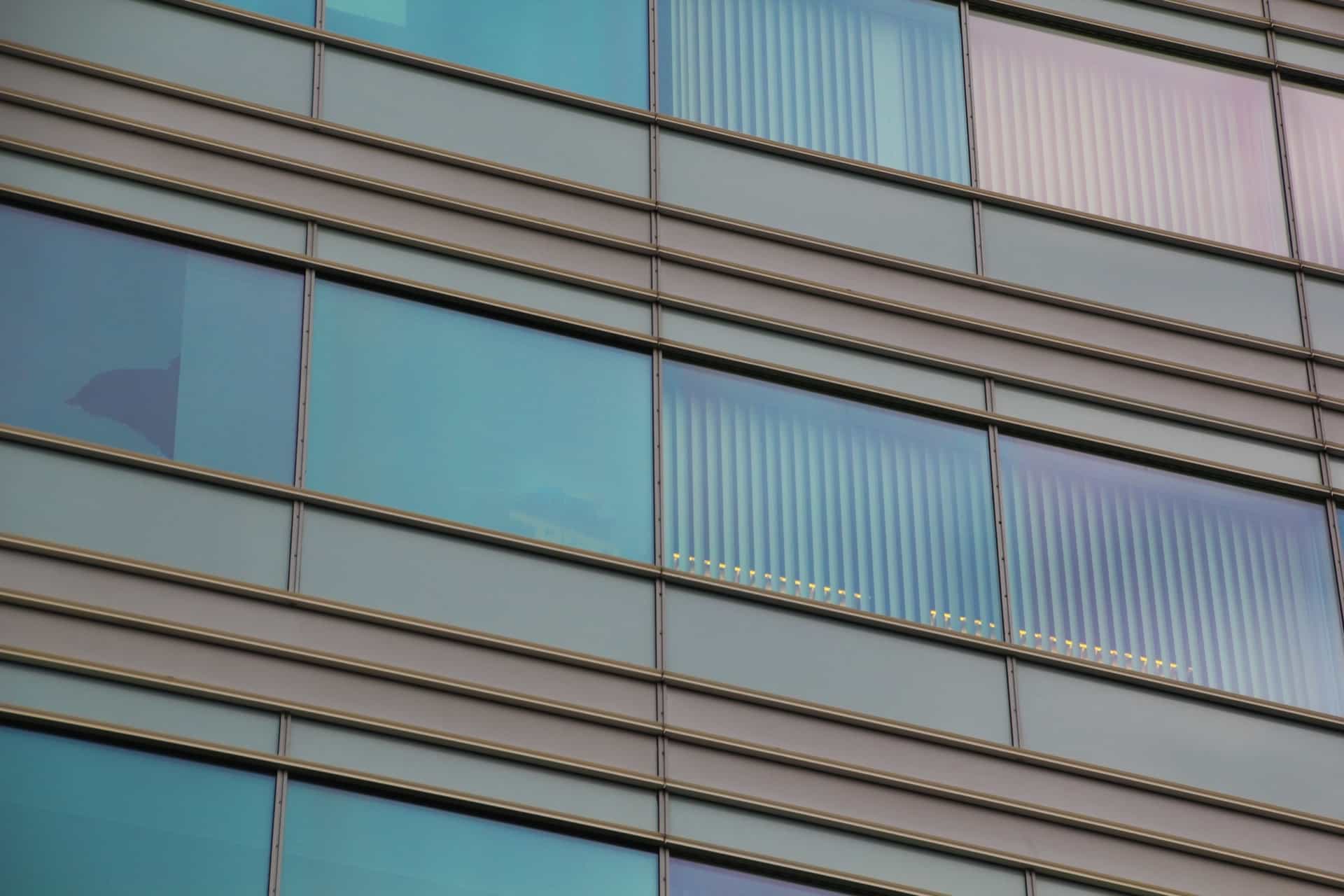
Tinted & Privacy Glass
Reduce glare, heat gain, and visibility with tinted glass.
Tinted & Privacy Glass
Reduce glare, heat gain, and visibility with our range of tinted glass solutions. Perfect for sun-facing windows and commercial facades.
Tinted glass is engineered to reject solar heat at the glass itself instead of intercepting it after the fact with film. For NJ commercial work, that distinction matters: the 2024 IECC and NJ-amended IBC Energy Conservation Construction Code (N.J.A.C. 5:23-3.18) set hard maximum SHGC values for vertical fenestration that you can only hit with tinted, spectrally-selective, or Low-E coated glass. We fabricate and install tinted IGUs from Vitro (PPG), Guardian, Pilkington (NSG), and Cardinal across the full range of NJ commercial and high-end residential projects.
There are two genuinely different tinted-glass technologies and they are not interchangeable: traditional body-tinted (dyed-in-the-melt) glass and modern spectrally-selective ceramic coatings. Body tints (bronze, gray, green, blue) absorb solar energy throughout the body of the glass and re-radiate it both inward and outward. Ceramic and pyrolytic Low-E coatings reflect specific solar bands while staying nearly colorless. The right specification depends on SHGC target, visible light requirement, building elevation, and whether you're meeting prescriptive or performance-path energy code.
Body-tinted vs. coated tinted — the real differences
Body-tinted glass: iron oxide, cobalt, or selenium added to the molten glass batch. The color is uniform through the thickness of the lite. Standard colors: PPG Solexia (light green), PPG Solargray, Guardian SuperGray, Pilkington Optifloat Bronze. SHGC of 1/4" body tint alone ranges 0.50-0.65 — not low enough by itself to meet most commercial energy code, must be combined with a Low-E coating in IGU.
Pyrolytic Low-E tinted (hard coat): tin-oxide coating fused into the glass at the float-line. Vitro Solarban 60, 70, 90 series and Guardian SunGuard SN series. SHGC as low as 0.23 in IGU with neutral, slightly green color. The default specification for NJ Class A office work in the last 15 years.
Sputter-coated Low-E (soft coat): magnetron-sputtered silver layers between dielectric oxides. Guardian SunGuard Solar, Vitro Solarban 90, Cardinal LoE3-366. SHGC down to 0.18 with the highest visible-light transmission in the industry. Soft coat must be sealed inside an IGU (it oxidizes if exposed) — never single-pane on commercial work.
Spectrally-selective ceramic coating: the newest commercial tier (Vitro Solarban 90, Guardian SunGuard SNX 51/23). Engineered to pass visible light (450-700nm) while rejecting near-infrared (700-2500nm). Hits SHGC 0.23 with 51% VLT — combinations that body tints physically cannot reach because they reject visible and IR roughly proportionally.
NJ energy code and SHGC compliance
N.J.A.C. 5:23-3.18 adopts the 2024 IECC for commercial buildings, with the ASHRAE 90.1-2022 alternative compliance path. For vertical fenestration in NJ Climate Zones 4A and 5A (counties split — see DCA bulletin for your specific county), the prescriptive SHGC maximum is 0.36 for fixed glazing and 0.36 for operable. Skylights are 0.40.
Practical implication: a project specifying clear annealed glass or single-pane tinted glass without a low-e coating cannot pass commercial energy code in NJ. You need either a Low-E IGU (most common), spectrally-selective coated IGU, or a body-tinted IGU with applied film that brings the combined SHGC under 0.36. The COMcheck or 90.1 envelope calculation must document the as-installed SHGC.
Performance path: ASHRAE 90.1 Appendix G or COMcheck trade-off lets a designer balance higher SHGC in one area against lower in another. We work with the project's energy consultant to spec the glass that hits the project-wide envelope budget — sometimes a slightly higher SHGC on the north elevation is acceptable if south and west are deeper into compliance.
Daylighting credit interaction: LEED v4.1 EQc7 (Daylight) and prerequisite EQp4 set minimum VLT levels. A glass spec that rejects too much visible light to hit SHGC will fail the daylighting credit. Spectrally-selective coatings exist exactly to thread this needle — high VLT, low SHGC.
Residential applications for tinted glass
High-end residential is rarely a pure code compliance exercise — NJ residential energy code (IECC Table R402.1.2) allows U-factor 0.28 prescriptive in our Zone 5A, with SHGC unregulated here, achievable with standard Low-E IGU without aggressive tinting. Where we install tinted glass on residential is when the homeowner has a specific glare or heat problem on a sunroom, west-facing great-room wall of glass, or a pool/spa enclosure.
Aesthetic tints: bronze, gray, and blue body tints are sometimes specified by architects for visual coherence with brick or copper accents. Color samples should always be viewed at full IGU thickness with the homeowner's specific Low-E coating — the apparent color shifts significantly when combined.
Bird-strike mitigation: NJ's bird-strike concentration along migratory corridors (Cape May County in particular) increasingly drives spec for fritted, dotted, or UV-pattern glass on lakefront and shore properties. Body tints don't help bird strikes — patterned or fritted glass does. We coordinate with NJ Audubon for any spec on properties they consult on.
Common NJ commercial tinted-glass projects
Office building re-skin: aging 1980s and 1990s reflective gray glass replaced with current-spec spectrally-selective coated IGU. The new glass keeps a similar appearance from the street while cutting solar heat gain, and with it the cooling load, and meeting current energy code.
Restaurant and retail storefronts: 1" insulated tinted glass in 2" aluminum storefront systems. Spectrally-selective coatings let the merchandise display stay bright while keeping the storefront from becoming a solar oven in summer.
Medical office buildings: hospital and clinic glazing in the Princeton-Plainsboro, Hackensack, and Cherry Hill corridors. Privacy glass (high reflectivity outward) combined with low SHGC and high VLT for daylit clinical spaces.
Pharma and lab facilities along Route 1: ASHRAE 90.1 compliance with very tight envelope budgets because the interior process loads are already so high. We work directly with the project's commissioning agent to verify as-installed glass matches the spec.
Our Process
- 1Spec consultationWe meet with the architect, energy consultant, or owner and review the SHGC target, visible-light requirement, code path (prescriptive or performance), and aesthetic goals. We pull product specs and NFRC labels for review.
- 2Sample mockupFor any commercial job over 500 sq ft, we provide full IGU samples in the actual specified make-up — body tint, Low-E surface, gas fill, spacer color. Samples are viewed at the building elevation under actual daylighting conditions, not in a fluorescent-lit office.
- 3FabricationTinted IGUs are fabricated by our manufacturer partners (PPG, Cardinal, Vitro through certified IGU fabricators) with 3-4 week lead time on standard, 6-8 weeks on spectrally-selective coatings. Each IGU is laser-etched with the NFRC label, manufacturing date, and unit serial.
- 4InstallationGlazing crews install in coordination with the GC's framing trade. Setting blocks, glazing tape, structural silicone where required. Each IGU is inspected for coating defects, edge damage, and seal integrity before glazing.
- 5Commissioning verificationOn LEED, ASHRAE 90.1 performance-path, or NJCEP rebate projects, we provide NFRC label photos, manufacturer affidavits of the installed glass, and as-built IGU schedules for the commissioning report.
Materials We Use
The Precision Difference
About Tinted & Privacy Glass in NJ
What SHGC do I need for a commercial building in NJ?+
What's the difference between tinted glass and Low-E coated glass?+
Will tinted glass make my office too dark?+
Can I replace just one tinted IGU and color-match the existing windows?+
What's the lead time for tinted IGU fabrication?+
Are there NJ rebates for energy-efficient commercial glazing?+
Does tinted glass affect my view at night?+
Serving All 21 New Jersey Counties
We service Atlantic County, Bergen County, Burlington County, Camden County, Cape May County, Cumberland County, Essex County, Gloucester County, Hudson County, Hunterdon County, Mercer County, Middlesex County, Monmouth County, Morris County, Ocean County, Passaic County, Salem County, Somerset County, Sussex County, Union County, Warren County. From our Garfield, NJ shop we cover the entire state, same-day in Bergen County, and elsewhere depending on the job and how booked we are that day.
Explore More
GLASS INSTALLATION
Full-service glass installation across New Jersey — residential, commercial, and architectural. Cut, tempered, laminated, and insulated glass installed to NJ Uniform Construction Code.
DetailsWINDOW TINTING & UV PROTECTION FILM
Window tinting and UV film — block 99% of harmful UV rays without replacing the glass.
DetailsSECURITY & PRIVACY WINDOW FILM
Safety, security, privacy and decorative window film — 3M and LLumar, installed on the glass you already have.
DetailsCOMMERCIAL WINDOW LEAK REPAIR
Forensic water-intrusion diagnosis and permanent leak repair for commercial windows, storefronts, and curtain-wall systems across NJ. We find the actual source — sealant, flashing, or framing — and fix it once.
Details