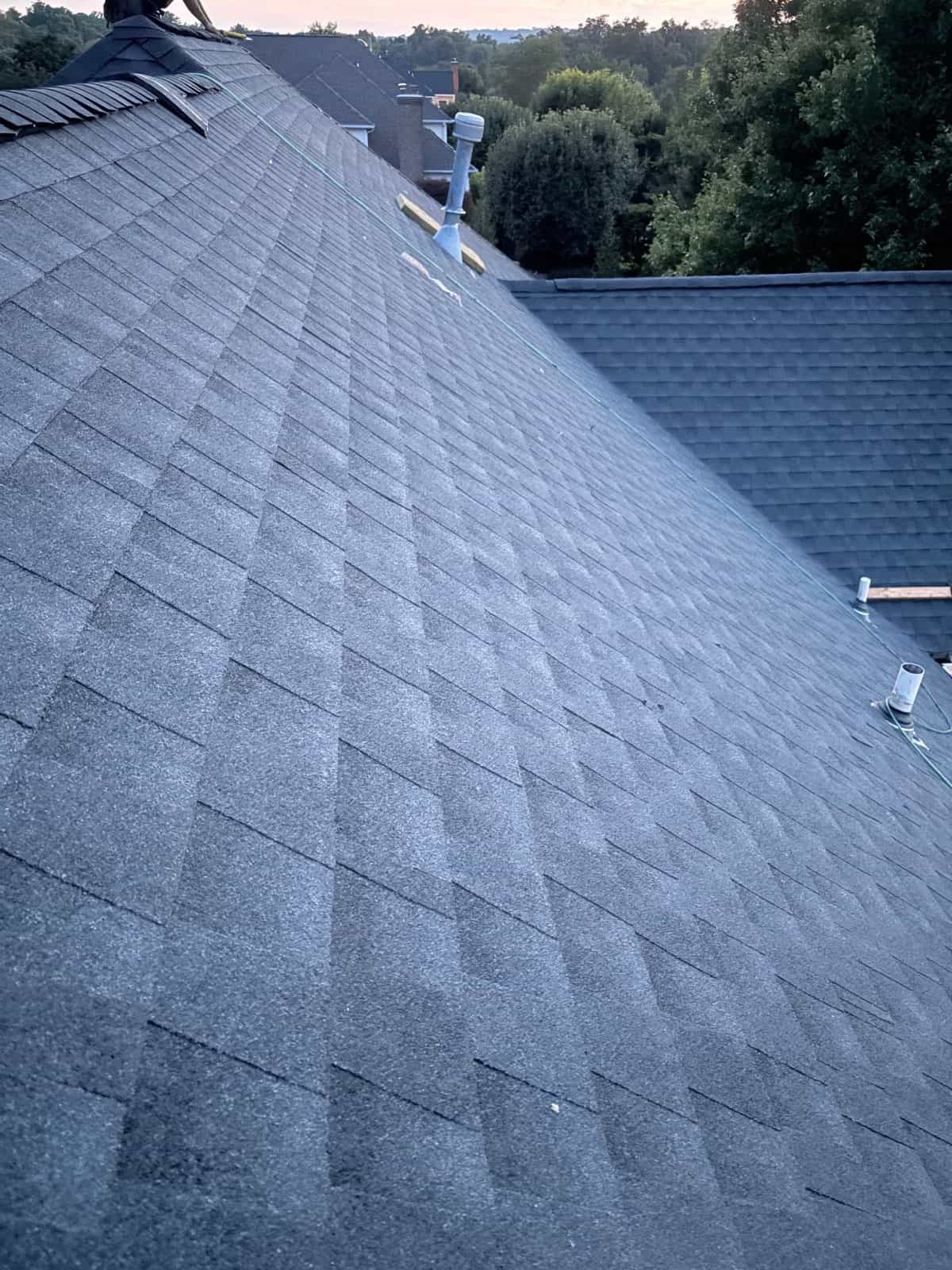
Usually close, rarely identical. A new shingle is a different age from the ones around it, so a wind repair can disappear from the street or read as a patch, and which one you get depends on three things you can check: the color code most makers print on the product, whether they are the smaller English size or the larger metric size, and whether the old shingles around the repair can be lifted without cracking.
Those facts also decide what happens next. When the match is good and the repair can be done properly, a few missing shingles stay a repair. When it cannot be, the choice moves up to a slope or the whole roof. If water is coming in right now, start with emergency roof repair and come back when the roof is dry.
Color: a new shingle will not look like a weathered one
A new shingle will be close to the old ones in color but not identical, and the gap grows with the age of the roof. GAF says an older roof has gone through weathering, granule loss and subtle color fading, so matching by eye does not work, which is why GAF prints a color code on the back of its shingles.
Some of the difference is not age at all. The Asphalt Roofing Manufacturers Association (ARMA) lists five reasons even a brand-new roof can look different from the brochure, among them color shading, backing particles that rub onto the granules and staining from storage. Rainfall washes off the backing particles and weathering clears the staining, so part of a new roof's difference fades on its own. ARMA adds that shading may occur more frequently with black and other dark-colored shingles.
Lots matter too. GAF says bundles on a job should share a color code and have manufacturing dates as close together as possible, and that lots should never be mixed even when the color name is the same, because shingles from two plants can differ slightly. A repair brings in another lot.
Discontinued colors: the code still tells you what to ask for
A discontinued color does not make a sound repair impossible, but it can make a perfect match impossible. To find out, a contractor lifts an existing shingle, reads the color name and code the maker prints on it (GAF prints them on the back), photographs it, and gives both to a supplier, asking for the bundles with the closest production date. That is GAF's own procedure, and it replaces guessing from a swatch.
If the supplier no longer has that code, the options are the nearest current color or a larger repair. Color availability also varies by region; CertainTeed's Landmark data sheet tells readers to check which colors are sold in their area. A near-match color is a cosmetic compromise. What keeps water out is the right size, the nailing, the sealing and the overlap, none of which depends on color.
GAF also says using the officially documented shingle, verified by its color code, is typically required to keep warranty coverage, and that the wrong shingle or color can complicate a future claim. If your roof is under a shingle warranty, ask what a substitute does to it first.
Metric and English shingles: why a different size will not line up
Shingles that look alike from the ground come in two broad size families, and a shingle from one does not line up with courses laid in the other. GAF's Royal Sovereign three-tab sheet lists the English size at about 12 by 36 inches with a 5-inch exposure. GAF's Timberline HDZ sheet lists about 13-1/4 by 39-3/8 inches with a 5-5/8-inch exposure, and Owens Corning lists TruDefinition Duration at the same nominal 13-1/4 by 39-3/8 inches with a 5-5/8-inch exposure. The larger family is what the trade calls metric, and these figures are nominal.
Exposure is the strip of each shingle left showing, so it sets how far apart the course lines sit. At 5 inches against 5-5/8 inches the lines drift 5/8 of an inch apart with every course, and after ten courses the two layouts are more than six inches out. The widths differ too, so end joints and nails land in the wrong places. A 1989 patent assigned to GAF (US 4,825,616) describes the result when metric shingles go over English ones: no reference to keep courses level, visible distortion, and nails driven where the layers cantilever and tear. The patent is about laying one size over the other, but a mixed-size patch runs into the same drift.
The larger shingles differ between makers as well. CertainTeed's Landmark data sheet lists 13-1/4 by 38-3/4 inches with a 5-5/8-inch exposure, five-eighths of an inch shorter than the GAF and Owens Corning figures. So the question is which maker, line and size, and the exposure is the quick check: about 5 inches on the smaller size and about 5-5/8 on the larger.
For a repair, a shingle of the right size and exposure nails into the course with its neighbors, and one of another size leaves the mismatch above. Whether your size is still made is a supplier question, answered with the product line and the color code.
Lifting and hand-sealing: what a repair does to the shingles around it
A sound repair has to deal with the neighbors as well as the new shingle. Each shingle is held by nails and by a sealant strip that sun and warmth activate, and a disturbed or wind-lifted neighbor may not re-bond by itself. GAF's hand-sealing bulletin (TAB-R-114) lists performing repairs among the times to hand-seal with roofing cement, and its Timberline instructions say shingles damaged by wind before they seal, or with dirty sealant, may never seal on their own.
The amounts are specific to each shingle. GAF's Timberline instructions call for four quarter-sized dabs of shingle tab adhesive, and warn that asphalt plastic cement (ASTM D4586) must go on in a thin layer under 1/8 inch; Owens Corning's cold-weather bulletin calls for four 1-inch dabs of roof cement on laminate shingles. Both warn that too much cement can blister the shingles.
Stiff shingles crack when bent. ARMA says shingles lose flexibility as temperature falls, advises extra care, including warming them, wherever one has to be lifted or bent, and warns that lifting may crack it during or after installation. An old roof can be brittle too: our guide to whether a 20-year-old roof should be replaced describes shingles that crack under a knee instead of flexing, which is worth knowing before anyone lifts one.
That is how a three-shingle repair becomes a larger one: on a brittle roof a repair can damage more shingles than the wind did. Ask for the inspection to check whether the shingles around the damage still bend; that tells you more about the job than the count of missing shingles.
Keep a spare bundle and write down the code
Keep one bundle from any roof you pay for, because a shingle from your own production run is the match you cannot buy later. Ask the installer to leave one and to write the product line, color name, color code and size on the invoice.
GAF prints the color name and code on both ends of each bundle, with the date, time and plant on one end, so photograph the label. Keep the bundle dry and indoors. It will not have weathered, and GAF notes that temporary asphalt staining can appear on new shingles in storage; it is cosmetic and weathers out. A spare from the right lot still beats an approximate color from a supplier's shelf.
When it will not match: repair, one slope, or the whole roof
A repair is right when the match is good enough and the old shingles can take being lifted, one slope is the next step when they cannot, and the whole roof is the answer when the roof is also near the end of its life. For what wind damage looks like, see roof storm damage and insurance claims; for repair versus replacement in general, see roof repair.
- Extent. A few lifted or creased shingles on one slope is a repair. Damage spread across the field is not.
- Match. A matched color and size supports a repair. A size no longer made, or a color with no current equivalent, pushes toward replacing the slope so the new shingles are uniform across it.
- The neighbors. If the shingles around the damage crack when lifted, the repair grows with every one that breaks.
- Age. On a roof near the end of its life, a patch that matches is still a patch. See the 20-year-old roof guide.
What a repair costs, and where matching moves it
On an ordinary single-family roof with a walkable pitch, a few wind-lifted or creased shingles on one slope run about $300 to $1,000 for the whole job, and a single-leak repair runs about $250 to $1,800, with the diagnosis free. A shingle that is hard to match pushes a repair toward the top of its range or past it, as do a steep or multi-story roof and a wider area of damage.
Replacing one slope depends on its size, layers and decking, so it is quoted in writing after an inspection. For the whole roof, see our roof replacement cost guide.
Does insurance have to match undamaged shingles in New Jersey?
New Jersey's claims-handling rule does not say so, which leaves matching to the language of your policy and the way the claim is handled. The rule is N.J.A.C. 11:2-17, Unfair Claims Settlement Practices. It covers how fairly insurers must settle, itemized depreciation, hidden damage tied to the loss, and a bar on requiring a particular contractor as a condition of payment unless the insurer is exercising a repair right under the policy. Nothing in it requires an insurer to replace undamaged shingles so the roof looks uniform.
That does not mean a policy never pays for matching. The Department of Banking and Insurance (DOBI) describes replacement cost as the amount to repair or replace with materials of like kind and quality at today's prices, and what that means for undamaged neighbors turns on your policy wording and the facts of the claim. Nor is the adjuster's estimate final. N.J.A.C. 11:2-17.10 requires an estimate the insurer settles on to allow for repairs made to generally accepted standards for safe and proper repairs, subject to policy conditions, and if your contractor's written estimate is higher, the company must review it and respond within 10 working days.
DOBI's consumer guide says the insurer should give you a copy of the damage estimate, that you need not use its recommended contractor, and that it can help to have your contractor speak with the adjuster. For a dispute it lists the company's internal appeals panel, the Insurance Claims Ombudsman, the appraisal clause in your policy, and the Department's complaint form.
We can document the damage and the match problem with photos for the adjuster, and the carrier decides. We cannot promise that a claim will be approved or that an insurer will pay for a slope or a roof. The claim steps are on our storm damage claim page.
So will a shingle repair match?
Close enough is realistic and identical is not. What decides which you get is settled before the first shingle goes on: the color code, the size, and whether the old shingles can be lifted. If the match is good, a repair is the right size of job, and if it is not, you should hear that before the work starts.
Ask for the free roof inspection from the Garfield shop to check all three, and we show you photos. If a repair will do, we say so. If the honest answer is a slope, we say that too. (201) 275-9185, HIC reg.# 13VH13970900.
Sources (read October 24, 2026)
Manufacturers and regulators revise these documents, so check the current version for your shingle and your policy.
- GAF, How to Read and Master GAF's Shingle Color Codes for Fast, Perfect Matching, February 3, 2026: https://www.gaf.com/en-us/blog/residential-roofing/how-to-read-and-master-gafs-shingle-color-codes-for-fast-perfect-matching-9dbab5fb-e3bb-40a5-acf5-8e00fbe771a3
- ARMA, Variations in Color Appearance on Newly Installed Asphalt Shingle Roofs, revised April 2024: https://www.asphaltroofing.org/wp-content/uploads/2020/12/Variation-in-Color-Appearance-on-Newly-Installed-Asphalt-Shingle-Roofs-4.2024-FINAL.pdf
- GAF, Royal Sovereign Shingles Product Information Sheet (English, 12 x 36), October 18, 2016: https://www.gaf.com/en-us/document-library/documents/data-sheets/royal-sovereign-english-(10-16)-_data-sheet.pdf
- GAF, Timberline HDZ Shingles Spec Sheet, RESGN467HDZ: https://www.gaf.com/en-us/document-library/documents/specifications/timberline-hdz-shingles-spec-sheet-resgn467hdz.pdf
- Owens Corning, TruDefinition Duration Shingles product page (nominal size and exposure): https://www.owenscorning.com/en-us/roofing/shingles/trudefinition-duration
- CertainTeed, Landmark Shingles Technical Data Sheet (copy hosted by BuildSite): https://www.buildsite.com/pdf/certainteed/Landmark-Shingles-Product-Data-2899919.pdf
- U.S. Patent 4,825,616, Roofing Shingle (GAF Corporation), granted May 2, 1989: https://patents.google.com/patent/US4825616
- GAF, TAB-R-114 Hand-Sealing Shingles, R2 April 17, 2024: https://www.gaf.com/en-us/document-library/documents/technical-bulletins-&-notes/r-114-hand-sealing-shingles.pdf
- GAF, Timberline Installation Instructions, RESTL622 (4/23): https://www.gaf.com/en-us/document-library/documents/installation-instructions-&-guides/timberline-layerlock-installation-instructions-trilingual-restl622.pdf
- Owens Corning, Technical Bulletin TB-10022497-A, Cold Weather Shingle Installation, April 2026: https://www.owenscorning.com/dms/10022497
- ARMA, Recommendations for Installation of Asphalt Roofing Shingles in Cold Weather, March 28, 2022: https://asphaltroofing.org/recommendations-for-installation-of-asphalt-roofing-shingles-in-cold-weather/
- New Jersey Administrative Code, N.J.A.C. 11:2-17, Unfair Claims Settlement Practices (sections 11:2-17.1 through 17.15), as published by Cornell LII: https://www.law.cornell.edu/regulations/new-jersey/title-11/chapter-2/subchapter-17
- New Jersey Department of Banking and Insurance, Insuring Your Home consumer guide: https://www.nj.gov/dobi/division_consumers/pdf/insuringyourhome.pdf