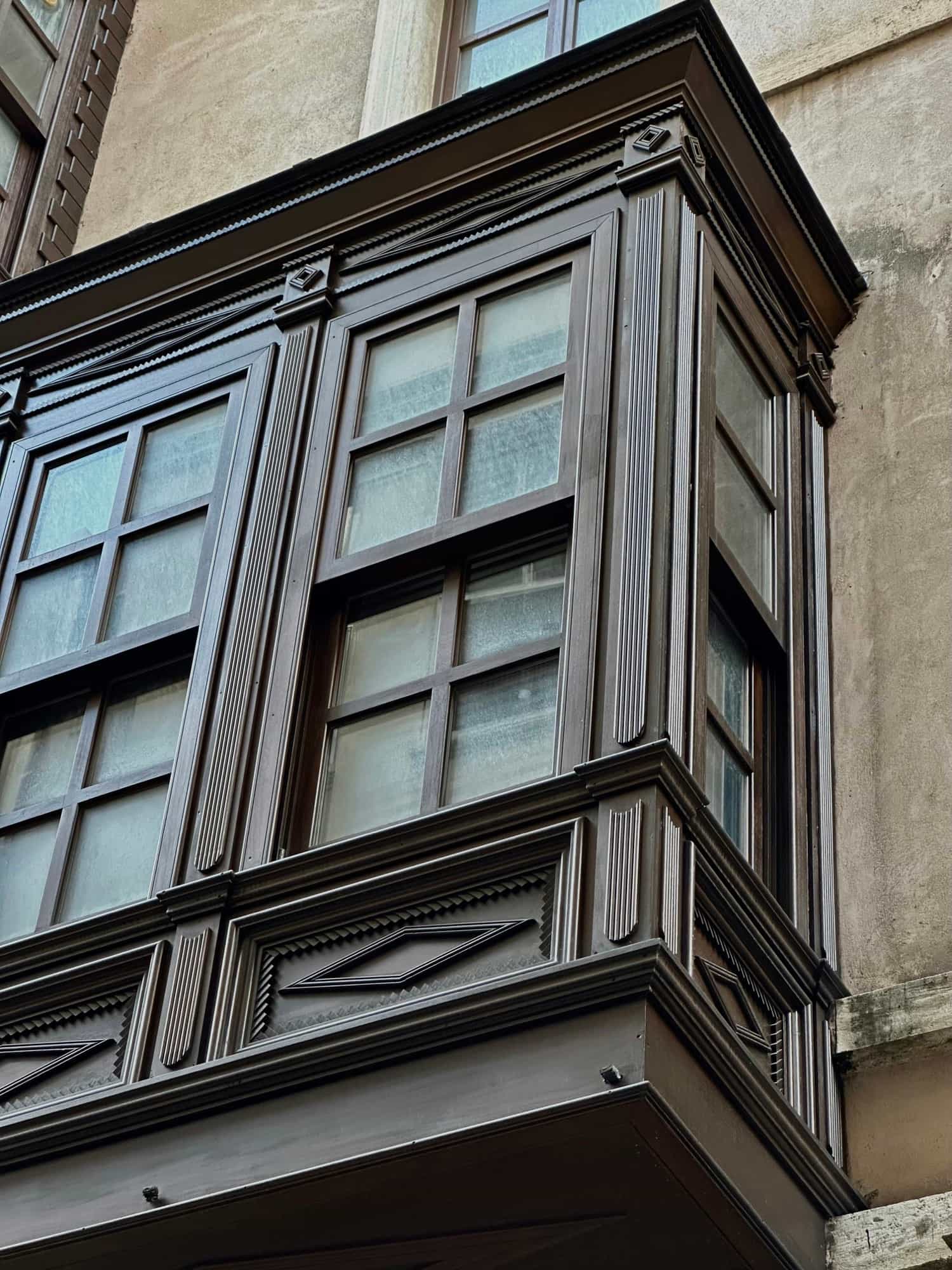
Bay & Bow Windows
Projection windows that add space, light, and architectural character.
Bay & Bow Windows
Add dimension and elegance to your home. Bay and bow windows project outward, creating extra interior space, a cozy window seat, and panoramic views.
Bay and bow windows are structural assemblies, not just windows. The unit projects out 12 to 24 inches beyond the wall plane, which means everything that was inside the wall plane — the load path from the wall studs to the foundation — now has to bridge the projection. Done right, a bay window adds a 30 sq ft reading nook and a 25-year roof. Done wrong, it sags two inches at the front edge within a decade and starts pulling drywall cracks through the room above it.
We've installed bays and bows across every NJ housing type: 1920s Tudor revivals in Montclair, 1950s Cape Cods in Toms River, 1980s colonial revivals in Marlboro, and 2010s modern farmhouses in Bernardsville. The aesthetic varies. The structural engineering doesn't. Every projection unit we install gets a header sized for the roof load above it, a seat-board built to span the projection without deflection, support cables or knee braces tied back to the wall studs, and a roof system that drains away from the house with proper kickout flashing at both ends.
Bay vs bow: the structural difference
A bay window is a three-unit assembly: a center fixed (picture) unit parallel to the house wall, flanked by two angled units (typically 30, 45, or 90 degrees). The mullions between units are where the structural mullion covers carry vertical load. A bow window is a curved assembly of four, five, or six units (usually casements at 10-15 degrees each) that creates a softer arc. Bows don't have the strong vertical mullion lines of a bay, which means they distribute load differently and usually need an additional support strategy — typically support cables from the head jamb to the king studs above.
Bays project further than bows for the same wall opening width because of the geometry. A 90-degree bay (rare but specifiable) projects almost the full width of the side units. A 30-degree bay projects roughly half that. A bow with five 10-degree units projects only 8-10 inches but spans a wider opening and looks more elegant on a Victorian or Craftsman elevation.
We quote both options for any project where the homeowner is undecided. Bays tend to suit traditional and colonial homes; bows suit Victorians, Queen Annes, and homes with curved interior features. Both work fine on contemporary architecture if the trim detail is appropriate.
Header sizing and load path
The header above a bay window has to carry the same roof load it carried before plus any new load introduced by the projection. We size headers per the IRC R602.7 prescriptive tables for typical spans and per the manufacturer's recommended header for the specific unit (Andersen, Marvin, and Pella all publish required header specs in their installation manuals). For a typical 8-foot wide bay carrying a 28-foot tributary roof span, we're looking at a double 2x12 SPF or LVL header — often LVL (1.75x11.875 or 1.75x14) to keep the depth manageable in retrofit framing.
When we remove an existing window and convert to a bay, we re-check the header. Original headers sized for a 4-foot double-hung are rarely adequate for a 7- or 8-foot bay rough opening. We size up to LVL and add king studs and full-height jack studs to either side. On second-floor installs we also check the floor framing below for adequate point load transfer — sometimes adding a doubled joist or a beam under the projection.
The projection itself needs a seat board (the horizontal platform at the bottom of the bay) sized to span without deflection. Standard 3/4 inch ply over 2x6 framing is the minimum we use. For deeper projections (20+ inches) we use 2x8 framing with 5/4 plywood or torsion-box construction. The seat board ties back to the original wall framing with metal straps or lag bolts into the king studs.
Support strategies: knee braces vs cables vs cantilever
Three ways to support a bay or bow projection against gravity and snow load: knee braces from below the projection back to the house wall (the traditional method, visible from outside, common on 1920s Tudor and Craftsman homes), tension cables from the head jamb up to the framing above (invisible from outside, used by Andersen and Marvin as standard on most modern bays), and full cantilever where the floor framing is extended to support the projection without any other bracing (only feasible during new construction or major remodel where the floor system is open).
Cable systems are now the dominant approach for retrofit and new install. Andersen ships their bays with factory-tensioned support cables that anchor to two-by lumber in the framing above the head jamb. We add a second redundant cable on any bay over 8 feet wide or over 18 inches projection. The cable doesn't carry the full load — it controls deflection so the unit doesn't sag over time. The seat board and structural mullions carry the dead load to the wall.
On historic homes where the original look had knee braces, we replicate them in milled cedar or fiber cement, tied through the sheathing into blocking. The braces are partly structural and partly aesthetic — we engineer the cables to do the actual work and treat the braces as a finish detail.
Roof, head flashing, and the leak details that matter
Every bay and bow needs its own roof. Stock units from Andersen and Marvin ship with a factory-built copper or aluminum roof at a 30 or 45 degree pitch that ties into the house wall above the unit. For custom or oversized bays we build the roof on site — standing seam metal or shingles over ice-and-water shield over 5/8 ply, with a step flashing where the bay roof meets the house wall.
The kickout flashing where the bay roof terminates at each end is the single most common failure point. If the kickout isn't installed (or is installed wrong), water sheeting down the house wall above the bay runs off the end of the bay roof and behind the side siding, then sits in the wall cavity and rots out the king stud. We install a fabricated copper or aluminum kickout at every bay-roof-to-house-wall junction. Code (IRC R903.2.1) requires it. Most original installs don't have it.
The head flashing above the unit needs to extend behind the house wall sheathing at least 4 inches and weather-lap over the unit's nailing fin. We use either rigid metal flashing or self-adhered membrane (Grace Vycor Plus, Henry Blueskin) tied into the WRB. Below the unit, on the seat board, we install a sloped sill pan that drains any incidental water back to the exterior — no flat horizontal surfaces inside the flashing assembly.
Insulating the seat board and head — where bays leak conditioned air
The two big air-sealing failures on bay windows are the underside of the seat board (between the bay floor and the house wall below it) and the top of the head jamb (between the bay roof and the house wall above it). Both are concealed once the trim goes on, and both are where you'll find ice damage and condensation if they're done poorly.
Under the seat board we install 2 inches of closed-cell spray foam directly to the underside, then build a soffit with R-19 batt and 1/2 inch ply enclosure. The spray foam is the air seal; the batt is the thermal. Above the head, we spray foam the cavity between the bay roof framing and the wall framing, then insulate the bay roof with closed-cell foam between rafters (R-25+ minimum for our climate zone).
Done right, the bay performs at or above the rest of the wall. Done wrong, it's a 30 sq ft cold spot in your living room that drips condensation in February. We've removed and rebuilt enough failed bays from the 1990s-era big-box renovations to know what doesn't work.
Our Process
- 1Initial design consultWe discuss bay vs bow geometry, projection depth, unit configuration (number of units, fixed vs operable, mullion angles), interior shelf or seat treatment, and exterior cladding match. For HPC-regulated properties we coordinate with the local Historic Preservation Commission before committing to a profile.
- 2Structural review and measureWe measure the existing rough opening, evaluate the existing header, check tributary roof load, and confirm or upsize the header. For loads above standard tables we engage a licensed PE for stamped calcs. Floor framing below the projection is verified for point load.
- 3Order and lead timeStock Andersen bays in standard sizes: 5-7 weeks. Marvin Ultimate custom bays: 8-12 weeks. Pella Reserve custom bows: 10-14 weeks. We track production and schedule install once the units ship and clear our warehouse.
- 4Demolition and framingOld window and surrounding trim removed. New header installed, king studs and jacks added. Floor framing below modified if needed. Sheathing cut back, WRB cut and lapped to expose the rough opening for the bay assembly.
- 5Bay install and structural tie-inUnit set with shims at the sill and head, cable supports tensioned to manufacturer spec, structural mullion covers fastened, seat board built and tied back to king studs. Roof framing set on the bay top with proper pitch toward the house wall.
- 6Flashing, cladding, and trimSelf-adhered head flashing installed, step flashing at the bay roof to house wall, kickout flashing at both ends. Bay roof shingled or metal-clad. Exterior trim matched to existing siding or specified architectural detail. Interior trim, seat top, and skirt installed.
- 7Insulation and final inspectionSpray foam at seat board underside and head cavity. Batt insulation in soffit and bay roof. Final operational test on any operable units. Walkthrough with homeowner, warranty registration, and photo documentation of the concealed details for future reference.
Materials We Use
The Precision Difference
About Bay & Bow Windows in NJ
How much does a bay window project from the wall?+
Does a bay window need its own roof?+
Will a bay window sag over time?+
Can I put a bench seat or shelves in a bay window?+
Do I need a permit to install a bay window in NJ?+
Bay vs bow — which one is right for my house?+
How long will a bay window last in NJ weather?+
Guides on this
- Bay vs bow: fit and cost factors
Which geometry suits which opening, what drives the price difference, and where each one tends to fail in NJ weather.
Serving All 21 New Jersey Counties
We service Atlantic County, Bergen County, Burlington County, Camden County, Cape May County, Cumberland County, Essex County, Gloucester County, Hudson County, Hunterdon County, Mercer County, Middlesex County, Monmouth County, Morris County, Ocean County, Passaic County, Salem County, Somerset County, Sussex County, Union County, Warren County. From our Garfield, NJ shop we cover the entire state, same-day in Bergen County, and elsewhere depending on the job and how booked we are that day.
Explore More
ARCHITECTURAL SPECIALTY SHAPES
Custom-shaped windows from circles and arches to trapezoids and octagons.
DetailsSTANDARD WINDOW INSTALLATION
Professional installation of double-hung, single-hung, and slider windows.
DetailsENERGY EFFICIENT REPLACEMENTS
Low-E and argon-filled windows that lower heating and cooling bills.
DetailsHISTORICAL SASH RESTORATION
Preserve the character of your historic home with sash restoration.
Details